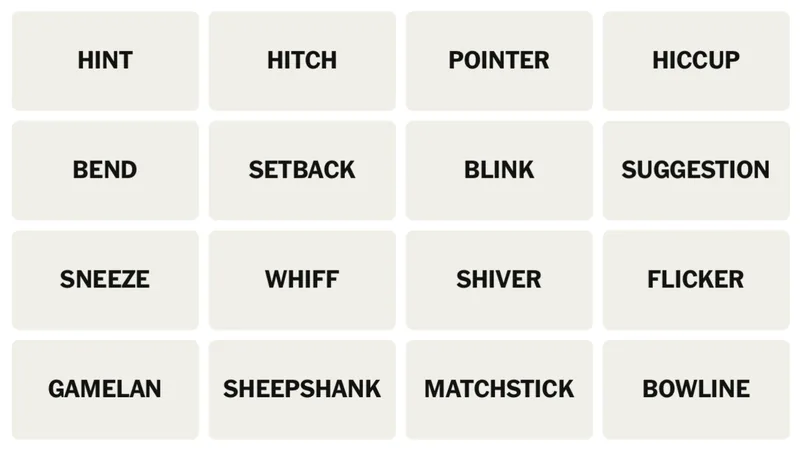
Have you ever found yourself staring at a grid of 16 words, scratching your head as you search for hidden connections? That's the delightful challenge of the New York Times Connections game--a word puzzle that tests your ability to find common threads between seemingly unrelated words. Today's NYT Connections hints will help you crack Tuesday's puzzle while sharpening your cognitive skills in the process.
Understanding Today's Puzzle
The Connections game presents 16 words grouped into four categories of four words each. Your task is to identify these connections, ranging from straightforward groupings to clever wordplay. The categories are color-coded by difficulty: yellow (easiest), green (moderate), blue (challenging), and purple (hardest).
For today's NYT Connections hints, we're looking at puzzle #1059 from May 5, 2026. This particular puzzle features an interesting mix of concrete nouns, action verbs, and some clever wordplay that might trip up even seasoned players.
Strategic Hints for Solvers
Before diving into the specific hints, here's a general approach that works well for many Connections puzzles:
- Start by scanning words that seem to have obvious connections
- Look for words that might fit multiple categories (these are often tricky)
- Don't get fixated on the first category you think you've identified
- Consider both literal and metaphorical meanings of words
For today's NYT Connections hints, let's look at what types of categories to expect:
- Yellow category - Similar nouns
- Green category - Related verbs
- Blue category - Related nouns
- Purple category - Wordplay
And here are some thematic hints to get you thinking:
- Yellow category - It's barely there.
- Green category - Performed automatically.
- Blue category - They keep things secure.
- Purple category - They have hidden words you might see at Wimbledon, for example.
Be careful with some of these words. For instance, "HINT" might be used to describe a flavor profile, such as "I'm detecting a HINT of lemon." Meanwhile, "HICCUP" refers to a literal hiccup, not a setback. And "HITCH" relates to something a Boy Scout might learn how to tie.
Today's Solutions
Ready to see how today's puzzle breaks down? Here are the four categories with their themes and words:
Yellow Category: GLIMMER
The most straightforward category today includes words that refer to small, subtle indications of something:
- FLICKER
- HINT
- SUGGESTION
- WHIFF
Green Category: INVOLUNTARY ACTIONS
This category contains actions that happen automatically, without conscious control:
- BLINK
- HICCUP
- SHIVER
- SNEEZE
Blue Category: KINDS OF KNOTS
The blue category brings together different types of knots you might tie:
- BEND
- BOWLINE
- HITCH
- SHEEPSHANK
Purple Category: STARTING WITH UNITS IN COMPETITION
The trickiest category today features words that contain hidden units you might find in competitive sports, particularly tennis:
- GAMELAN (contains "game")
- MATCHSTICK (contains "match")
- POINTER (contains "point")
- SETBACK (contains "set")
Improving Your Connections Game
Now that you've seen today's solutions, here's how to approach future puzzles with more confidence:
First, pay attention to words that seem to have no obvious connections. These often hold the key to the most challenging categories. For example, in a recent puzzle, "WHISTLER" initially seemed related to sound, but it was actually part of a group of painters (along with CLOSE, MUNCH, and another name).
Another strategy is to look for words that might have multiple meanings. The word "BEND" could refer to a curve in shape, a type of knot, or even a musical performance. Context is everything!
When you're stuck, try categorizing words by their grammatical function. Are they mostly nouns, verbs, or adjectives? This can help narrow down possible connections.
Finally, don't be afraid to take breaks. Your brain continues to work on the puzzle subconsciously, and you might return with fresh insights.
With these strategies and today's NYT Connections hints, you're well-equipped to tackle puzzle #1059 and future challenges. Remember, the goal isn't just to find the answers but to enjoy the process of discovering unexpected connections between words--a skill that translates to better critical thinking in all areas of life.