Have you ever seen a piece of technology and immediately thought, "Why would anyone make this?" You're not alone. When Chinese tech firm Bigme teased what they called the "world's first" dual-screen smartphone, featuring both an e-ink and an LCD display, my mind raced with possibilities. But the reality of the Hibreak Dual? It's a design so peculiar, it genuinely made me laugh out loud.
The Porthole Problem
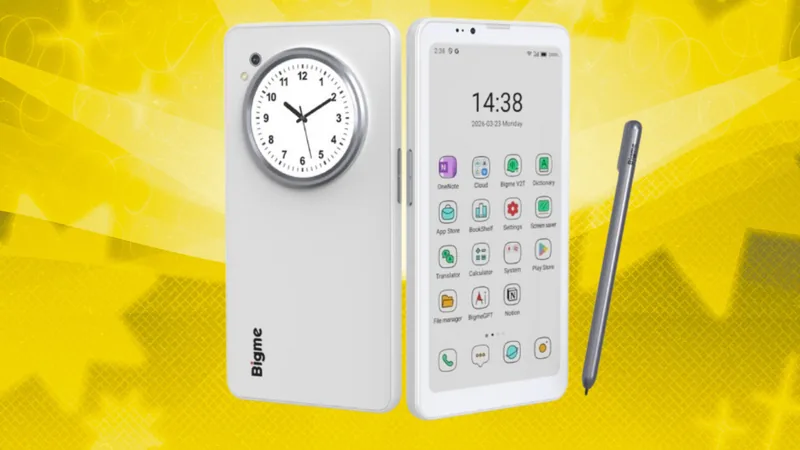
On one side, the Hibreak Dual delivers what you'd expect from a premium e-reader: a 6.13-inch, 300 PPI black-and-white (or 150 PPI color) e-ink display. It even supports stylus input, a nice touch. But the flip side is where things take a sharp, baffling turn. Instead of a full-color LCD screen as many anticipated, the back of the device sports a tiny, circular touchscreen. It's less of a secondary display and more like a porthole on a submarine, prompting the immediate question: what is this for?
Bigme claims this circular LCD is a "secondary screen" for notifications, music control, or checking the time. While e-ink displays are static until refreshed, meaning an always-on display for quick info has some logic, it clashes with the core appeal of e-ink devices. People often choose e-ink for fewer distractions. Do they really want a phone that still bombards them with alerts, just on a screen too small to easily read? It's reminiscent of the days of the illegible front displays on flip phones like the original Motorola Razr - a feature most people happily left behind (Credit: Velimir Zeland/Shutterstock).
Confused Intentions and Odd Demos
Even the promotional materials for this dual screen e-ink/lcd device seem to underscore the confusion. One video shows a model awkwardly interacting with the tiny circular screen, attempting to snap selfies and watch videos that are clearly designed for a wider aspect ratio, leaving significant black bars. The suggestion to use it for taking pictures of your pet, or layering a chatbot to create an "AI pet," feels like a stretch, a desperate attempt to justify the unconventional design.
The online reaction on forums like Reddit's r/Bigme echoed this sentiment, with comments like "This can't be more disappointing." Bigme's response hinted at acknowledging the disconnect: "This product combines an e-ink main screen with an LCD subscreen [supporting] functions like viewing images, watching videos, [and] receiving call reminders... This design keeps you in an eye-friendly experience while using the LCD functions that e-ink alone handles less effectively." They also noted they've "heard your requests for a full-screen dual e-ink and LCD phone (both displays large) and will include that in our future product planning." It's surprising it took this much feedback to reach that conclusion.
Pricing and Specs of a Curiosity
If, against all odds, you're intrigued by the Hibreak Dual, Bigme is offering it in a surprising eight configurations. You can choose between black-and-white or color e-ink, 8GB or 12GB of RAM, and 128GB or 256GB of storage, with or without a stylus and case. Prices start at $519 and go up to $689 for the top-tier model. For context, the Bigme Hibreak Pro Color, which lacks the porthole LCD, is available for $489 on Amazon.
Beyond the peculiar secondary screen, the Hibreak Dual offers fairly standard specs for an e-ink phone: 5G, Android 14, a generic octa-core 2.6GHz processor, a 4,500mAh battery, a 5MP selfie camera, and a 20MP rear camera. These are solid, if unremarkable, features. But the core question remains: who is this dual screen e-ink/lcd phone truly for?
It feels like a product born from a brainstorming session where someone suggested "What if we put a tiny screen on the back?" without fully considering the user experience or practical application. While it's fascinating to see companies experiment with new form factors, the Hibreak Dual stands out as a prime example of innovation for innovation's sake, rather than solving a real user problem. Perhaps future iterations will land closer to a sensible design, but for now, this particular dual screen e-ink/lcd experiment remains a perplexing, albeit memorable, piece of tech.