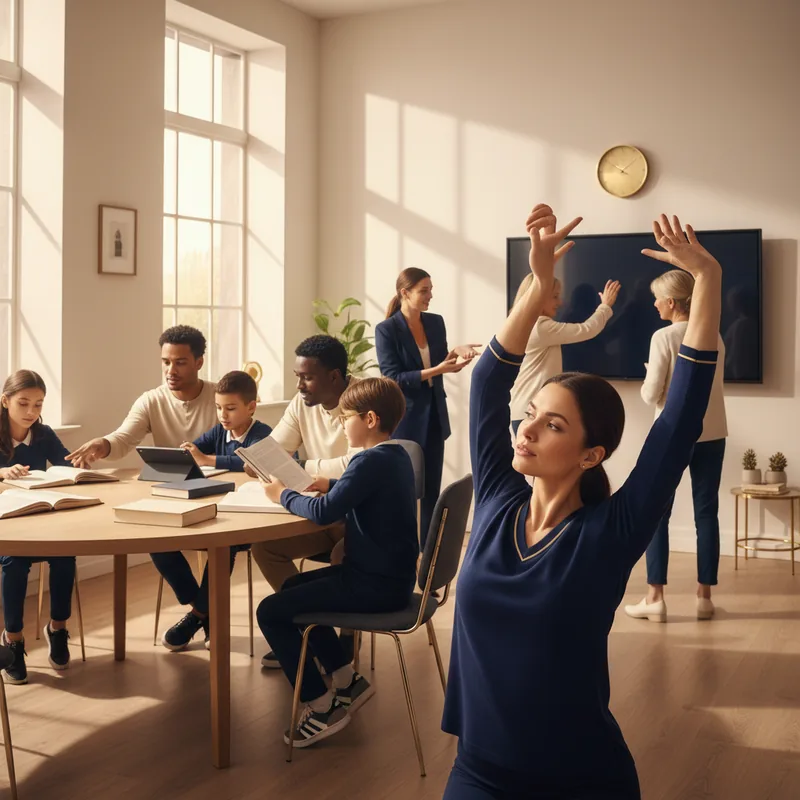
Picture this: You're at a new gym, unsure how to use a particular machine. You glance over, watch someone effortlessly complete a set, and suddenly, you understand. Or perhaps you've seen a child mimic a parent's elaborate hand gesture, perfectly capturing the nuance without a single lesson. These everyday moments are vivid illustrations of a powerful psychological phenomenon: observational learning.
So, how observational learning affects our behavior is profound, shaping everything from our basic social interactions to complex skill acquisition. It's the process where we acquire new knowledge, skills, attitudes, or behaviors simply by watching others, retaining that information, and potentially replicating it later (Bandura, 1977). Unlike direct experience that relies on personal rewards or punishments, observational learning allows us to learn indirectly, often without conscious effort, serving as a cornerstone of human development and socialization.
The Essence of Observational Learning
Observational learning goes by many names, including modeling, shaping, or vicarious reinforcement, but its core principle remains consistent: learning through observation. While it's particularly prevalent and critical during childhood development, playing a vital role in how children learn social norms and appropriate responses from caregivers, it continues to influence us throughout our lives (Gross et al., 2015).
We don't, however, simply imitate every action we witness. Our inclination to mimic is influenced by various factors, such as our perceived similarity to the model, the outcomes the model experiences, and our own confidence in our ability to perform the observed behavior. Understanding these underlying mechanisms is key to recognizing when observational learning is a constructive force for personal growth and when it might inadvertently lead to less desirable outcomes, such as adopting negative habits seen on social media (Routinova Research, 2024).
A Historical Perspective: Bandura's Breakthrough
For a significant period in psychological research, the emphasis was often placed on direct forms of learning, such as environmental conditioning or the impact of rewards and punishments. However, the pioneering work of psychologist Albert Bandura and his colleagues brought observational learning to the forefront, demonstrating its immense power in shaping human behavior through social interactions within families, peer groups, and broader communities (Bandura, 1977).
Bandura's groundbreaking social learning theory underscored the critical role of observation. Studies suggest that meaningful imitation, accompanied by social understanding, typically emerges around two years of age, though this timeline can vary among individuals (Gross et al., 2015). Interestingly, research indicates that infants develop their ability to imitate by being imitated themselves, highlighting the reciprocal nature of early learning. Sensitive caregivers who mirror their babies' sounds and actions actively foster this crucial developmental skill (Essler et al., 2023).
The Iconic Bobo Doll Experiment
Perhaps the most famous demonstration of observational learning is Bandura's Bobo Doll experiment. In this landmark study, young children observed an adult model interacting aggressively with a large, inflatable Bobo doll. The children were then given the opportunity to play with the same doll. The results were striking: children who witnessed the aggressive behavior were significantly more likely to imitate those actions.
Crucially, the consequences the adult model faced also influenced the children's behavior. Children were more prone to imitate aggression if the adult received no punishment or was even rewarded for their actions. Conversely, if the adult was punished for aggressive behavior, children were less likely to replicate it. This experiment vividly illustrates how observational learning affects the adoption and inhibition of behaviors, especially through vicarious reinforcement or punishment (Bandura, 1961).
Everyday Impact: Real-World Examples
Observational learning is an omnipresent force in our daily lives, often operating beneath our conscious awareness. Here are several instances that clearly demonstrate its influence:
- A child watches their parent meticulously fold laundry, later picking up a shirt and attempting to imitate the folding motion, gradually mastering the task.
- A young couple dines at an authentic Asian restaurant. Observing other patrons expertly using chopsticks, they discreetly copy the movements, quickly gaining proficiency with the utensils.
- During a schoolyard game, a child witnesses a classmate being reprimanded for hitting another. From this observation, they learn that aggressive physical contact leads to negative consequences and adjust their own behavior.
- Joining a group of friends playing hide-and-seek, a new child, initially unsure of the rules, quickly grasps the game's mechanics by watching others and seamlessly joins in.
- A beginner in a yoga class observes the instructor's precise alignment in a warrior pose. By mirroring the instructor's body position, they learn the correct form without explicit verbal instructions.
- An individual seeking to reduce their environmental footprint notices their friends consistently sorting recyclables and composting food waste. Inspired by this observed behavior, they adopt similar sustainable practices in their own home.
- A new employee, starting their first corporate job, observes how senior colleagues communicate in meetings, dress for client interactions, and manage their time, thereby learning the unspoken rules and culture of the workplace.
The Four Stages of Observational Learning
For observational learning to lead to meaningful behavioral change, it typically involves a sequence of four interconnected stages, as proposed by Bandura. These stages move beyond simple imitation, incorporating cognitive and motivational components that determine whether an observed behavior is ultimately adopted or avoided.
Attention: Focusing on the Model
The first crucial step is attention. For an observer to learn, they must actively focus on the model's behavior. This requires a certain level of cognitive energy and sustained engagement. Factors influencing attention include the model's perceived reward for their behavior, their attractiveness, and how similar they are to the observer. We are more likely to pay attention to models who are charismatic, successful, or who we can relate to (Psychological Review, 2023).
Retention: Remembering What You Saw
Once attention is captured, the observer must be able to retain the information. This involves encoding the observed behavior into memory, often through mental images or verbal descriptions. If the observer cannot recall what they witnessed, the learning process falters, necessitating a return to the attention stage. Effective retention is about creating a mental blueprint of the observed action (Cognitive Psychology Journal, 2024).
Reproduction: Practicing the Behavior
With the behavior retained in memory, the next stage is reproduction--attempting to replicate the observed action. This step involves translating the mental blueprint into physical action. It's important to acknowledge that individual capabilities vary; even with perfect attention and retention, some behaviors may be physically or skill-wise challenging to copy immediately. Practice and refinement are often necessary to achieve accurate reproduction.
Motivation: The Drive to Act
Finally, for the observer to actually perform the newly learned behavior, there must be a motivating factor. Even if an individual can perfectly reproduce an action, they may not do so without the drive. Motivation is often fueled by vicarious reinforcement: witnessing the model being rewarded for their behavior significantly increases the likelihood that the observer will also engage in that behavior, especially if they anticipate similar positive outcomes. Conversely, observing a model being punished can decrease motivation (Bandura, 1977).
What Influences Our Imitation?
While observational learning is undeniably potent, it doesn't mean we passively mimic every action we see. Bandura's research highlighted several key factors that significantly increase the probability of a behavior being imitated. These influences explain why certain actions catch on more readily than others, and how observational learning affects societal trends and individual habits.
We are significantly more inclined to imitate individuals who are perceived as:
- Warm and Nurturing: People who exhibit kindness and support often serve as more influential models.
- Receiving Rewards: When models are visibly rewarded for their actions, observers are more motivated to emulate them.
- Authoritative Figures: Individuals in positions of power or expertise tend to command more imitation.
- Similar to Ourselves: We are more likely to copy those who share our age, gender, interests, or background.
- Admired or High Status: Celebrities, leaders, or those with high social standing often become powerful models.
- Past Success: If we've been rewarded for imitating behavior in the past, we're more likely to do so again.
- Lacking Confidence: In situations where we feel uncertain about our own abilities, we often look to others for guidance.
- Ambiguous Situations: When faced with unfamiliar or confusing circumstances, observing others provides cues on how to act.
The human tendency to imitate is a subject of intense interest across psychology, education, and public health. Understanding these drivers allows us to strategically encourage positive behaviors, such as promoting healthy habits through visible role models, while also developing strategies to steer individuals away from harmful or destructive actions (Carrignon et al., 2022).
The Dual Nature: Benefits and Drawbacks
Learning by observing others offers immense advantages, allowing for rapid skill acquisition and the efficient transmission of cultural knowledge. However, like any powerful psychological mechanism, it also carries potential downsides, particularly when the observed behaviors are detrimental to personal growth or societal well-being.
Advantages of Learning by Observation
Observational learning is an incredibly efficient way to acquire new skills and navigate new environments. It allows us to learn complex behaviors without the need for trial-and-error, which can be time-consuming or even dangerous. From learning a new dance move to understanding appropriate social conduct in a foreign country, observing others provides a shortcut to competence. It's how children learn language, manners, and safety precautions, and how adults adapt to new jobs or social groups (Mukhalalati et al., 2022).
Potential Pitfalls and Concerns
The same mechanism that allows us to learn positive behaviors can also facilitate the adoption of negative ones. There has been significant concern, particularly in the wake of Bandura's research, about how observational learning affects children and teenagers when exposed to aggressive or risky content. Early studies, for instance, explored a direct link between violent video games and short-term aggression (Anderson & Dill, 2000).
More recent and comprehensive longitudinal research, however, has provided a nuanced perspective, often finding no direct, long-term causal connection between video game playing and violent behavior, although short-term effects on aggression or empathy might still be observed (Kühn et al., 2019). Similarly, older research on sexual media exposure and adolescent sexual behavior found no general connection between watching explicit content and subsequent sexual activity within a year (Gottfried et al., 2013).
However, a 2020 analysis published in *PLoS One* indicated that exposure to sexually explicit media during early adolescence *is* linked to risky sexual behavior later in early adulthood (Lin et al., 2020). This highlights that while individuals don't just blindly imitate everything they see, the context--including the model's identity, the social environment, and parental involvement--plays a crucial role. Researchers emphasize that early exposure to concerning material can indeed increase risky behavior, underscoring the importance of prevention programs and improved media literacy to mitigate these effects (Routinova Health, 2024).
Harnessing Observational Learning for Growth
Understanding the intricate dynamics of observational learning provides powerful tools for personal development, education, and public health initiatives. By consciously applying its principles, we can cultivate positive habits, strengthen desired skills, and effectively discourage detrimental behaviors in ourselves and others.
Acquiring New Skills and Habits
Observational learning is an invaluable tool for skill acquisition. Whether in a classroom setting where students observe a teacher's demonstration, or at home where children watch parents perform daily chores, this method allows for efficient transfer of practical knowledge. For adults, it's how we learn a new software interface by watching a tutorial or master a craft by observing an expert artisan. Consciously seeking out positive role models can accelerate personal development and skill mastery.
Reinforcing Desired Behaviors
Beyond initial learning, observation can powerfully reinforce existing positive behaviors. Consider a student who observes a classmate receiving praise and a reward for actively participating in class. This vicarious reinforcement makes the observer more likely to raise their hand and contribute in the future. In workplaces, seeing a colleague rewarded for initiative encourages others to demonstrate similar proactive behaviors, illustrating how observational learning affects team dynamics and productivity.
Discouraging Unwanted Actions
Equally important, observational learning plays a significant role in reducing or eliminating undesirable behaviors. If an employee witnesses a colleague being disciplined for consistently missing deadlines, they are likely to internalize the negative consequence and become more diligent in managing their own tasks. This vicarious punishment acts as a powerful deterrent, guiding individuals away from actions that lead to negative outcomes. By strategically highlighting the repercussions of certain actions, we can utilize this principle to foster a safer and more ethical environment.