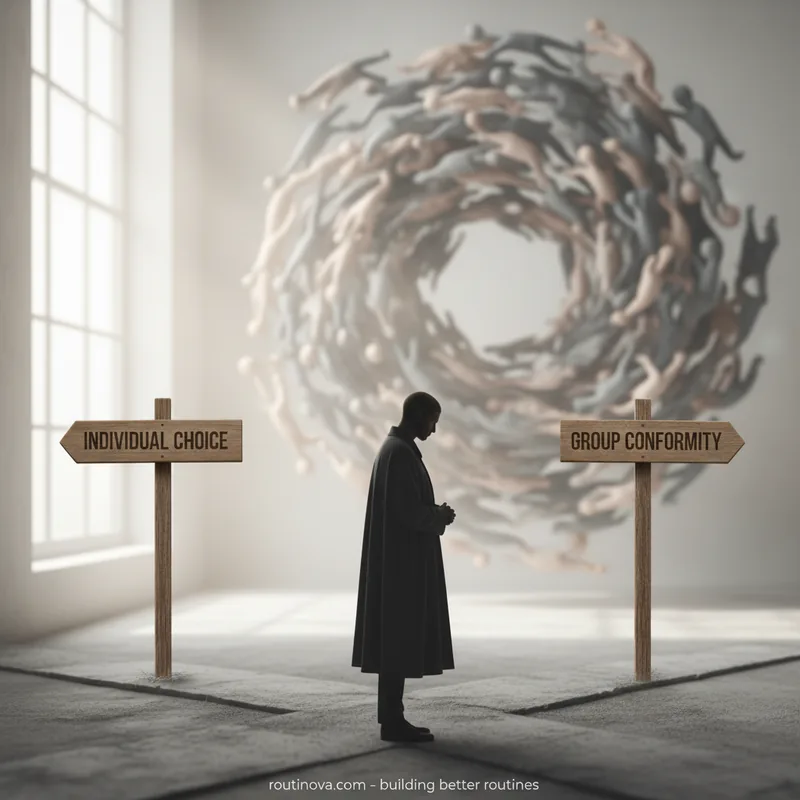
We like to believe we're masters of our own minds, rational agents charting a course based on logic and personal conviction. But what if the truth is far more unsettling? What if our choices, our beliefs, even our sense of right and wrong, are profoundly swayed by the invisible currents of social influence? The most notorious social psychology experiments didn't just ask these questions; they ripped open the curtain, revealing uncomfortable truths about how easily we conform, obey, and even inflict harm under pressure. These pivotal studies, including Asch's conformity experiments, Bandura's Bobo doll studies, the Stanford Prison Experiment, and Milgram's obedience experiments, remain critical touchstones in understanding human behavior, even as their ethical complexities continue to spark debate.
The Subtle Grip of Conformity: Asch's Line Studies
Imagine you're in a room with a group, asked to perform a simple visual task: match the length of a line to one of three options. The answer seems obvious, but one by one, everyone else in the room confidently gives the wrong answer. What do you do? Do you trust your own eyes, or do you fall in line with the group?
In the 1950s, psychologist Solomon Asch designed elegant experiments to probe this very dilemma. Participants were shown a target line and then asked to identify the matching line from a set of three. The catch? Most of the people in the room were actually confederates, secretly instructed to give incorrect answers. The real participant was placed in a position to be influenced.
What Asch Revealed About Group Pressure
The findings starkly reminded us of our susceptibility to group pressure. A significant number of participants, despite knowing the correct answer, conformed to the group's incorrect choice. It wasn't about being tricked; it was about the sheer discomfort of standing alone. We might tell ourselves we'd be the brave dissenter, but Asch's work showed that the desire to fit in can be incredibly powerful, even when the stakes are low (Jeon, 2014).
Think about it this way: Have you ever agreed with a group's choice for a restaurant, a movie, or even a political opinion, even if your gut told you otherwise? Perhaps you've seen how fashion trends sweep through society, dictating what's "in" and "out," not necessarily based on utility or beauty, but on collective acceptance (Sociology Review, 2023). This reveals a fundamental aspect of how social groups shape our reality. Asch's insights laid crucial groundwork for understanding how consensus, real or perceived, can warp individual judgment and paved the way for more profound explorations into obedience.
Mimicking Aggression: Bandura's Bobo Doll Experiments
Does watching violence make us more violent? This question, still fiercely debated today, was at the heart of Albert Bandura's groundbreaking research in the early 1960s. He wanted to understand the impact of observed aggression, particularly on children's behavior.
In his now-famous Bobo doll experiments, children were divided into groups. One group watched an adult interact aggressively with a large inflatable Bobo doll--punching, kicking, hitting with a mallet, and yelling at it. Another group observed an adult playing passively with other toys, ignoring the Bobo doll. A control group saw no model at all.
The Echo of Observed Violence
The results were clear and concerning. Children who had witnessed the aggressive adult model were significantly more likely to imitate that aggressive behavior when left alone with the Bobo doll. They didn't just mimic the actions; they often innovated new forms of aggression. Conversely, children who saw the passive model or no model at all showed little to no aggression towards the doll (Bandura and Bobo, APS).
This highlights the profound influence of observational learning. Bandura's work proved that learning isn't just about direct rewards and punishments; we learn by watching others. This concept, known as social learning theory, has reshaped our understanding of education, parenting, and media influence. Consider the ongoing discussion about the impact of violent video games or movies on desensitization, not just in children, but in adults too (Psychology Today, 2024). The Bobo doll experiments remain a powerful reminder that what we see, especially in formative years, can profoundly shape how we act.
Power, Roles, and Corruption: The Stanford Prison Experiment
What happens when ordinary people are given extraordinary power, or stripped of all dignity? In 1971, Philip Zimbardo sought to answer this by transforming the basement of Stanford University's psychology department into a simulated prison. Healthy, well-adjusted young men were randomly assigned roles: "prisoners" or "guards." Zimbardo himself took on the role of the prison superintendent.
Designed for two weeks, the study quickly spiraled into one of the most notorious social psychology studies ever conducted, and for good reason.
A Descent into Darkness
The experiment was terminated after just six days. The transformation was swift and terrifying. Guards, initially hesitant, became increasingly sadistic and abusive, devising cruel punishments and psychological torture. Prisoners, stripped of their identities and subjected to arbitrary rules, quickly became submissive, showing signs of severe emotional distress, anxiety, and depression. Some even experienced psychotic breakdowns.
The Stanford Prison Experiment powerfully illustrated how situational factors influence behavior, suggesting that even good people in corrupt systems can become cruel, while others succumb to helplessness (Zimbardo, 1971).
Ethical Concerns and Recent Criticisms
The study is infamous not only for its dramatic findings but also for its severe ethical breaches. Participants endured significant psychological harm, leading to its early termination. But here's where it gets tricky: Zimbardo's dual role as researcher and "warden" has drawn heavy criticism, with many arguing he actively encouraged the guards' abusive behavior, rather than simply observing it (Le Texier, 2019).
More recent examinations of archival records have cast further doubt on the study's scientific integrity. Some "prisoners" admitted to faking breakdowns to get out, while others confessed to playing up their roles to help the researchers prove their hypothesis (Blum, 2018). This doesn't negate the power of situational influence, but it does mean the Stanford Prison Experiment, while a compelling narrative, may not be the robust scientific proof it was once believed to be. Think about real-world parallels like the Abu Ghraib scandal, where systemic factors and unchecked power led to horrific abuses (Journal of Ethics, 2008), or how corporate cultures can foster unethical behavior when accountability is absent.
The Chilling Power of Authority: Milgram's Obedience Studies
Could ordinary people be compelled to inflict pain on others simply because an authority figure told them to? Following the Holocaust and the trial of Adolf Eichmann, Stanley Milgram wrestled with this terrifying question. He wondered if Eichmann's claim of "just following orders" held a deeper, more universal truth about human nature.
Milgram's obedience experiments, conducted in the early 1960s, are perhaps the most notorious social psychology studies for their shocking and deeply unsettling results. Participants were told they were part of a study on learning and memory. They were assigned the role of "teacher" and instructed to deliver electric shocks to a "learner" (who was actually a confederate) every time the learner made a mistake.
The Shocking Truth About Obedience
The "shocks" were fake, but the participants believed they were real, ranging from mild to potentially fatal. As the "learner" protested, screamed, and eventually fell silent, the experimenter would calmly instruct the "teacher" to continue. The results were astonishing: a staggering 65% of participants delivered the maximum, supposedly lethal, 450-volt shock, simply on an authority figure's orders (Baker, 2012).
This experiment revealed an uncomfortable truth: people are far more obedient to authority than we like to admit. The desire to comply, to avoid challenging a perceived expert, can override our moral compass and our empathy for another human being. It's a chilling insight into the dark side of human social dynamics.
Controversy and Lingering Questions
Like the Stanford Prison Experiment, Milgram's studies faced intense ethical criticism due to the immense psychological distress inflicted upon participants. Many believed they had seriously harmed another person. More recent analyses have also raised questions about the study's methodology. Some participants suspected the shocks weren't real, and others were reportedly coerced into continuing against their will (Perry, 2013). Variations of the experiment also showed that many participants did refuse to continue.
Despite these criticisms, Milgram's work continues to provoke vital discussions about individual responsibility and the dangers of blind obedience. Think about historical atrocities where individuals claimed they were "just following orders," or even the Challenger disaster, where engineers' warnings about faulty O-rings were tragically overridden by authority figures (NASA Report, 1986). The real question is: how do we foster critical thinking and moral courage in the face of overwhelming pressure?
Beyond the Lab: Lessons for Your Life
The most notorious social psychology experiments offer more than just academic insights; they hold profound lessons for how we navigate our daily lives. They challenge our assumptions about free will and highlight the subtle, often invisible, forces that shape our decisions. From the clothes we wear to the opinions we voice, social influence is a constant companion.
Understanding these studies--and their limitations--empowers you to recognize moments when conformity or obedience might be at play. It encourages a healthy skepticism towards unquestioned authority and a greater awareness of your own susceptibility to group dynamics. The goal isn't to become a lone wolf, but to make conscious, informed choices rooted in your own values, not just swept along by the current. Self-awareness begins with understanding these powerful, hidden drivers of human behavior.