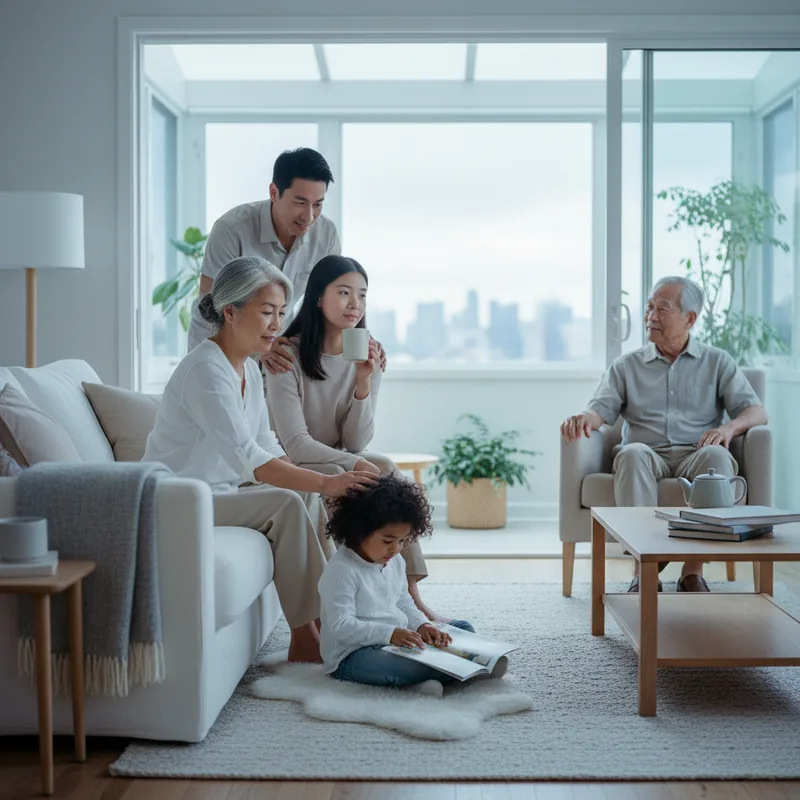
Picture this: A family dinner where conversations flow easily, yet some of the most profound messages are exchanged without a single word. Or perhaps, a moment of tension where silence hangs heavy, leaving unspoken feelings to fester. For many Asian American families, silence is not merely an absence of sound but a complex, deeply ingrained form of communication, playing a dual role in expressing both profound love and potential harm. This intricate dynamic stems from cultural values that prioritize group harmony and indirect communication, influencing how emotions are managed and relationships are maintained across generations.
Understanding Cultural Communication Foundations
The bedrock of communication patterns in Asian American families often lies in fundamental cultural distinctions between Eastern and Western societies. These differences shape how individuals perceive their place within a group and how they choose to express themselves, or not express themselves, verbally.
Individualism vs. Collectivism: Group Harmony Above All
A core divergence between Eastern and Western cultures is the emphasis on either the individual or the community. While Western societies often champion individualism, celebrating personal achievement, autonomy, and independence, Eastern cultures typically prioritize collectivism. This worldview values the needs of the group, community, and family above individual desires, fostering generosity over selfishness and harmony over conflict (Park & Kim, 2008).
Understanding this collectivist ethos is crucial for grasping the nuanced role of silence in Asian communication styles. To preserve relationships and maintain social harmony, individuals in Asian cultures frequently default to emotional suppression. The group's well-being takes precedence, and communication often becomes more indirect to prevent potential conflict or embarrassment (Butler et al., 2007). This sensitivity to others' needs means individuals are often more attuned to the unspoken cues and feelings of those around them, rather than focusing solely on their own.
High-Context vs. Low-Context Communication: Reading Between the Lines
The prioritization of group needs and the value placed on self-control, particularly emotional regulation, give rise to high-context communication patterns. In high-context cultures, less emphasis is placed on explicit verbal communication. Instead, meaning is inferred through indirect signals, non-verbal cues, interpersonal sensitivity, and the strategic use of silence (Fong & Philipsen, 2001).
Conversely, Western cultures typically employ low-context communication, which focuses on direct, explicit verbal expression. This style is often characterized by dominance, animation, openness, and confrontational approaches. Psychologist Dr. Jenny Wang, author and founder of asiansformentalhealth, highlights the beauty of community-oriented connection in high-context cultures but cautions that less direct communication can lead to assumptions and inaccurate inferences about others' needs and wants.
Within high-context communication, negative feelings are often conveyed ambiguously to maintain relational harmony and allow for 'saving face.' The responsibility then falls on the receiver to interpret and negotiate the meaning of these indirect messages. Dr. Wang suggests that while directness might feel uncomfortable, it can ultimately lead to deeper understanding and more effective support within relationships.
Silence as an Expression of Love and Care
In many Asian American families, the role of silence in expressing affection is profound and deeply rooted in cultural practices. Love is often demonstrated through actions and unspoken understanding rather than explicit verbal declarations.
Service-Based Affection: Actions Speak Louder
Asian values frequently emphasize anticipating the needs of others, reducing the necessity for verbal requests. This anticipatory care stems from highly developed inference skills, a strong sense of tradition, and keen observational abilities. This is a primary way Asian families convey love: through service-based actions. Examples include preparing and serving meals, fulfilling family obligations, sacrificing personal desires for another's benefit, or going out of one’s way to ease a family member's life (Uba, 2003).
Dr. Jenny Wang beautifully articulates this, noting that love expressed through acts of service is a tangible, felt experience. Children of Asian immigrants often describe knowing their parents love them, a cognitive understanding derived from these consistent actions. For instance, a parent might silently notice their child is stressed about an upcoming exam and leave a favorite homemade meal on their desk without a word, a clear gesture of support and care.
Another common example is a parent ensuring the house is always clean, stocked with preferred foods, or taking on extra chores without being asked, all as quiet affirmations of devotion. These declarations of love extend beyond verbal cues, centering on the health, welfare, and safety of their children and family members.
The Comfort of Implicit Support
Research indicates that for Asians and Asian Americans, implicit social support, which doesn't require active discussion of stressful events, can be more beneficial than explicit support (Yang et al., 2015). Implicit support involves deriving emotional comfort from social networks through shared pleasant activities or simply being in the company of close others, without verbalizing problems.
Given the action-oriented communication style, family members often anticipate needs and act independently rather than asking for help or discussing next steps. This could involve bringing food to a gathering, taking elder family members out for errands, or simply offering a comforting presence. However, Dr. Wang also stresses the importance of verbal and physical expressions of love, noting that spontaneous affirmation or affection, unattached to achievement, fosters a crucial sense of inherent worth and value.
The Detrimental Side: Silence as a Tool of Harm
While silence can convey deep affection, its misuse can also inflict significant emotional pain and create communication barriers, highlighting the darker role of silence in family dynamics.
The Silent Treatment: A Form of Control and Avoidance
The silent treatment, a response to disagreement or conflict, can be employed to avoid confrontation, punish, or exert control. It is a covert behavior—a deliberate enactment of aloofness, avoidance, and dismissiveness designed to discomfort and frustrate recipients (Rittenour et al., 2019). Kipling Williams, a psychology professor and expert on ostracism, describes the silent treatment as particularly controlling because it deprives both parties of the opportunity to engage, leaving the recipient powerless.
Often, the primary aim of the silent treatment is to manipulate another person's behavior. It's an alluring tactic for individuals who are intolerant of conflict, allowing them to disengage rather than directly addressing negative feelings, leaving the recipient to grapple with their emotions alone.
Trauma Response and Emotional Stonewalling
Dr. Wang offers a nuanced perspective, suggesting that the use of the silent treatment may not always be intentional. It can manifest as a trauma response when an individual feels threatened or overwhelmed, causing their nervous system to shut down. In such states, coherent speech or response becomes impossible. For example, a family member, overwhelmed by a tense discussion, might physically withdraw to another room, leaving others to wonder if they've done something unforgivable, rather than stating they need a break.
In Asian American families, where younger generations often adopt more direct communication styles from Western society, this can clash with a culture accustomed to conflict avoidance. Such confrontations can lead to relationship dissolution and stonewalling—an intense form of the silent treatment where an individual, inundated with negative emotions, completely withdraws (Driver et al., 2012).
Lasting Wounds: Impact on Self-Worth
The silent treatment can be profoundly painful because it denies another person's very existence. Dr. Nicole LePera, creator of The Holistic Psychologist, emphasizes the significant wounding this can cause, especially if experienced in childhood. When a child's survival depends on a caregiver who pretends they don't exist during upset, it can lead to deeply ingrained beliefs of unworthiness, conditional love, and the idea that one's actions lead to others shutting down.
Those on the receiving end of the silent treatment experience a threat to fundamental needs for belonging, self-esteem, control, and meaningful existence (Williams et al., 1998). Given the high value placed on familial structure and collectivism in Eastern cultures—including conformity, emotional self-control, and filial piety—the impact of a parent using the silent treatment on a child can be particularly harmful and long-lasting. A young adult, reflecting on childhood, might realize they often suppressed their own opinions or desires to avoid potential conflict or disapproval, internalizing a belief that their voice might disrupt family harmony.
Navigating Bicultural Identities and Fostering Healthier Communication
The evolving landscape of Asian American families necessitates a thoughtful approach to communication, bridging traditional values with contemporary needs.
Bridging Generational and Cultural Gaps
It's crucial to avoid viewing cultural differences through a deficit model, where one culture is deemed 'lesser.' Instead, Dr. Wang advocates for adding nuance and flexibility, recognizing that many second- and third-generation Asian Americans navigate bicultural lives. They can draw strengths from both their heritage and mainstream American cultures to enrich their communication styles.
As younger generations grow up, their bicultural identity often fosters improved skill development in negotiation, communication, and mental health literacy. This enables them to engage more effectively in relationships with their parents. While the onus for initiating these difficult conversations shouldn't solely fall on the child, Dr. Wang notes that due to generational and cultural gaps, children often possess the language and vernacular to broach these sensitive subjects.
Strategies for Constructive Dialogue
To approach arguments and conflicts more effectively, Dr. Wang offers several practical tips. Establishing a set of ground rules can create a safer space for discussion. This includes mutually agreeing on how to communicate the need for a break or space when feeling attacked or vulnerable. For instance, a phrase like, “I need a moment to collect my thoughts, let's revisit this in 30 minutes,” can be pre-agreed upon.
Another strategy is to align as problem-solvers rather than viewing each other as the problem. In moments of conflict, the tendency is often to assign blame. Instead, consciously reminding oneself, “I'm not the enemy; I'm your teammate here. How can we work together to solve this problem?” can shift the dynamic towards collaboration.
The Child's Role in Initiating Change
Directly talking through issues is a distinctly Western concept, and immigrant parents may not inherently understand or value this approach. Dr. Wang encourages individuals to reflect on the quality of their relationship with their parents: “Are we attuned, or are we in constant tension and conflict?” The goal is to disarm that tension to allow for deeper, more intimate conversations about difficult topics, even if it means the younger generation takes the lead in initiating these new communication patterns.
The Enduring Pursuit of Family Connection
The myriad ways silence manifests in Asian American families is emblematic of high-context communication patterns prevalent in Asian cultures. This intricate role of silence can be both profoundly beneficial, fostering deep, unspoken understanding and acts of love, and potentially detrimental, creating distance and emotional harm through avoidance or control. As traditional Asian culture continues to blend with mainstream American values, communication within Asian American families evolves, embracing a newfound bicultural identity (Kim et al., 2001).
Despite these evolving dynamics, the overarching goal remains constant: establishing and nurturing love, care, overall well-being, and unwavering support within the family. By understanding the complex role of silence in these relationships and actively working towards more balanced, direct, and empathetic communication, families can strengthen their bonds and navigate the rich tapestry of their bicultural experiences with greater harmony and understanding.