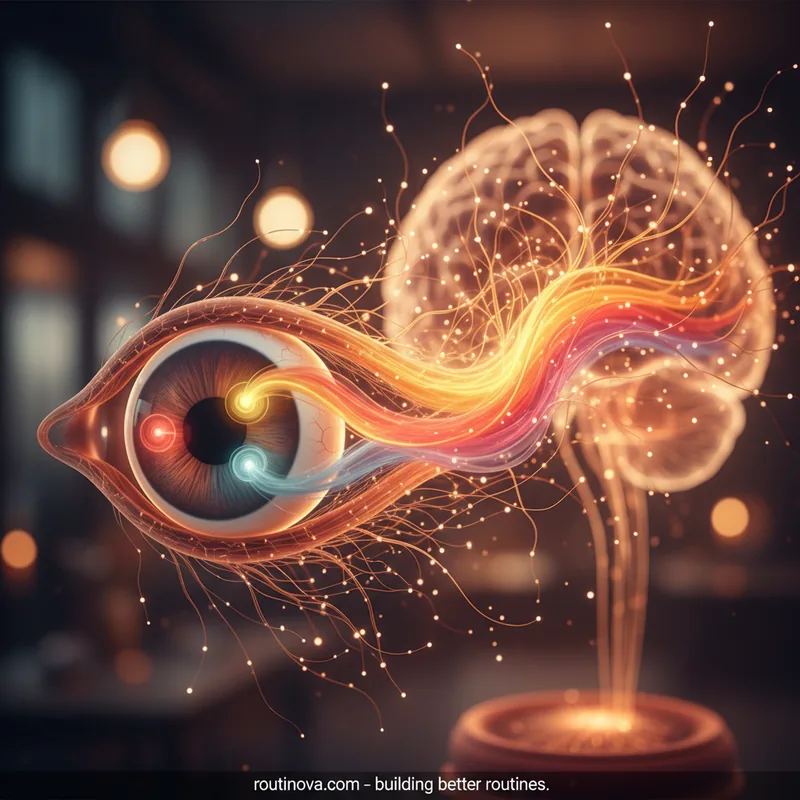
Have you ever looked at an image and seen something that simply couldn't be real? Lines that appear to bend, shapes that seem to move, or objects that change size before your eyes? If so, you've experienced the captivating world of optical illusions. These visual tricks aren't just for fun; they offer a profound glimpse into how your brain processes visual information, revealing the intricate mechanisms that construct our perception of reality. Understanding cool optical illusions and how they work can illuminate the very nature of sight and cognition.
Unraveling the Mysteries of Visual Deception
Optical illusions, more accurately termed visual illusions, are essentially deceptions of our vision. They exploit the way our eyes and brain collaborate to interpret the vast amount of visual stimuli we encounter daily. These illusions can occur due to a variety of factors, from the arrangement of an image and its color effects to light sources and inherent brain processing quirks. Sometimes, they can even be influenced by neurological or visual conditions, leading to fascinating and sometimes startling misperceptions of size, shape, color, or movement.
The core of these illusions lies in the brain's attempt to make sense of ambiguous or conflicting visual data. It's a testament to the brain's efficiency that it can construct a coherent visual world so quickly, but this efficiency also makes it susceptible to these clever tricks. Learning how cool optical illusions work helps us appreciate the active role our brain plays, constantly interpreting, inferring, and sometimes "filling in the blanks" to create a stable visual experience.
The Science Behind the Trick
Visual illusions arise from the complex interplay between our sensory organs and our cognitive processes. Our eyes capture light and convert it into electrical signals, but it's the brain that interprets these signals, constructing the images we perceive. This interpretation isn't always a direct translation; it's an active process influenced by past experiences, expectations, and the inherent structure of our visual system.
There are three primary categories of visual illusions:
- Physiological illusions occur when the image itself overstimulates or fatigues specific sensory pathways in the eyes or brain. Think of afterimages or geometric patterns that create a sense of movement.
- Cognitive illusions happen when the brain makes assumptions or inferences based on the visual information it receives. These illusions often rely on the brain's learned rules for interpreting the world, such as perspective or depth cues.
- Literal illusions are the most straightforward, involving images that can be interpreted in two distinct ways, often through combining multiple pictures or ambiguous figures.
Understanding these categories helps us categorize the diverse range of visual phenomena we experience. The way we perceive these illusions can also vary significantly from person to person, influenced by factors like attention, prior experiences, and even subtle differences in our visual processing capabilities (Cretenoud et al., 2021).
Classic Illusions and Their Mechanisms
Many optical illusions have captivated audiences for decades, serving as powerful examples of how our visual system can be tricked. Let's explore some of the most iconic ones and the scientific explanations behind them.
1. The Hermann Grid Illusion
This classic illusion presents a grid of black squares on a white background. At the intersections of the white lines, viewers often perceive faint gray dots that seem to shimmer or disappear when fixated upon.
Why it happens:
While lateral inhibition was a long-standing explanation--suggesting that the brightness of intersections overstimulates retinal cells, causing surrounding cells to inhibit their response--more recent theories point to the function of specific neurons in the primary visual cortex (S1 simple-cell theory) as a more comprehensive explanation. This theory posits that the way these neurons respond to specific patterns and contrasts creates the illusory dots (Glover & Lauzon, 2018).
2. The Spinning Dancer
The silhouette of a spinning dancer is famously ambiguous. Depending on how you view it, the dancer can appear to be spinning either clockwise or counterclockwise. What's fascinating is that most people can only perceive one direction at a time, and switching between perceptions can feel abrupt.
Why it happens:
This illusion is a prime example of bistable perception. The 2D silhouette lacks crucial depth cues, forcing the brain to interpret the ambiguous figure from two possible perspectives. When one perspective is favored, the brain fills in the missing spatial information, leading to a coherent, albeit subjective, perception of movement direction (Lucafò et al., 2016).
3. The Ames Room
The Ames room is a masterclass in manipulating perspective. It's a specially constructed room that appears normal from a specific viewing point but is, in reality, trapezoidal. When people of the same height stand in different corners, one appears vastly larger than the other.
Why it happens:
The illusion works because the room's distorted shape tricks the brain into assuming it's a standard rectangular or square room. The brain applies its usual rules for size constancy, assuming objects farther away appear smaller. Since the corner where the 'smaller' person stands is actually farther away, the brain perceives them as being smaller, even though they are the same size as the person in the 'closer' corner (Qian et al., 2016).
4. The Ponzo Illusion
This illusion features two identical lines placed over converging lines, resembling railway tracks. The line closer to the point where the tracks appear to converge looks longer, even though both lines are the same physical length.
Why it happens:
The Ponzo illusion leverages our understanding of linear perspective. The converging lines suggest depth, creating the impression that the upper line is farther away. Our brain interprets this as meaning the upper line must be larger to subtend the same visual angle as the closer, smaller-appearing line (Ninio, 2014).
5. The Zöllner Illusion
In the Zöllner illusion, a grid of long, parallel lines is overlaid with many short, slanted lines. The short lines disrupt the perception of the long lines, making them appear to converge or bend.
Why it happens:
The short, angled lines interfere with the brain's ability to accurately perceive the orientation of the longer lines. The brain interprets the confluence of these small angles as cues for depth or convergence, leading to the perception that the main lines are not parallel (American Psychological Association).
6. The Kanizsa Triangle
This illusion presents a compelling example of how the brain creates form. Viewers perceive a bright, white triangle superimposed on three black circles and another triangle outline, even though no such triangle is explicitly drawn.
Why it happens:
The Kanizsa triangle is a powerful demonstration of the Gestalt law of closure. Our brains tend to perceive incomplete figures as complete by mentally filling in the gaps. Here, the cut-out sections of the circles and the pac-man shapes are interpreted by the brain as forming the edges and surface of a triangle (Sakiyama et al., 2014).
7. The Müller-Lyer Illusion
Here, two lines of identical length are presented side-by-side. One line has arrowheads pointing outwards at its ends, while the other has arrowheads pointing inwards. The line with outward-pointing arrowheads appears significantly longer.
Why it happens:
One leading theory suggests the brain misapplies size constancy. We are accustomed to interpreting outward-pointing fins as representing corners projecting towards us (like the edge of a building), making the line seem further away and thus larger. Conversely, inward-pointing fins are seen as corners receding from us, making the line seem closer and smaller (Weidner et al., 2014).
8. The Moon Illusion
Anyone who has observed the night sky has likely noticed the moon illusion: the moon appears much larger when it's near the horizon than when it's high overhead.
Why it happens:
While there's no single, universally agreed-upon explanation, several factors are thought to contribute. One prominent theory involves apparent distance. When the moon is near the horizon, it's seen in context with terrestrial objects (trees, buildings), which provide depth cues that make it seem farther away. Because it subtends the same visual angle as when it's overhead, the brain interprets this as meaning it must be physically larger (Weidner et al., 2014). Atmospheric conditions and the moon's color can also play a role.
9. The Lilac Chaser
This illusion, first described in 2005, involves a black cross surrounded by eight dots of lilac. As you stare, the dots seem to disappear, and a green cross may briefly appear in their place.
Why it happens:
Two phenomena are at play here. Troxler's fading causes the peripheral lilac dots to disappear with prolonged fixation on the central cross. Simultaneously, an afterimage effect occurs. The prolonged stimulation of the photoreceptors by the lilac color causes them to become fatigued. When you then perceive the faint green dots (which are always present but less noticeable), the fatigued receptors respond less to the green, and the brain interprets this as a green cross filling the void left by the faded lilac dots (Bertamini, 2017; Bachy & Zaidi, 2014).
10. The Negative Picture Illusion
This illusion demonstrates how the visual system can create a full-color image from a black-and-white negative. Staring at a negative image of a face and then looking at a blank white space can reveal a positive, full-color afterimage.
Why it happens:
Prolonged exposure to specific colors and light intensities overstimulates and fatigues the corresponding photoreceptor cells (cones) in the retina. When you shift your gaze, these fatigued cells respond less intensely than the surrounding, rested cells. The brain interprets this difference in signal strength as the complementary color, creating the negative afterimage (Dong et al., 2017).
New Examples of Cool Optical Illusions
Beyond the classics, new and intriguing illusions continue to emerge, further illustrating the brain's interpretive powers. Here are a few more examples of cool optical illusions and how they work:
11. The Impossible Cube
Also known as the Necker Cube, this is a wire-frame drawing of a cube that can be perceived in two different ways. The ambiguity lies in which face of the cube appears to be in the front.
Why it happens:
Like the Spinning Dancer, the Impossible Cube is bistable. The 2D representation lacks depth cues, allowing the brain to interpret the vertex connections in two mutually exclusive ways, creating the perception of an impossible, self-intersecting object.
12. The Café Wall Illusion
This illusion features alternating rows of black and white tiles, separated by a line of gray mortar. The lines of mortar appear to be tilted, making the rows seem to be offset, even though they are perfectly parallel.
Why it happens:
The precise arrangement of the black and white tiles, particularly how they meet at the mortar lines, creates a contrast effect. The brain interprets the angles and brightness contrasts in a way that suggests a slight shift between the tile rows, leading to the perception of tilted mortar lines.
13. The Bent Rod Illusion
Imagine looking through a glass of water at a straight rod. The rod appears bent or broken at the point where it enters the water. This is a common everyday illusion.
Why it happens:
This illusion is caused by refraction. Light rays bend as they pass from one medium (water) to another (air). The change in the speed of light causes the rays to change direction, altering the path of light that reaches our eyes. Our brain interprets these bent light rays as if the object itself were bent.
Why Do Optical Illusions Trick Us?
Optical illusions work by exploiting the inherent assumptions and shortcuts our visual system uses to process the world. The brain is constantly trying to create the most probable interpretation of the visual scene based on past experiences and biological predispositions. When presented with ambiguous or manipulated visual information, these assumptions can lead to systematic errors in perception.
Key factors that contribute to these misperceptions include:
- Image Arrangement: The spatial relationships between elements in an image can create false impressions of size, distance, or movement.
- Color and Contrast: How colors interact and contrast with each other can influence our perception of brightness, hue, and even shape.
- Depth Cues: The brain uses various cues (like perspective, shading, and texture gradients) to perceive depth. Illusions often manipulate these cues to create false depth perceptions.
- Brain Processing: The way our neural pathways are wired and how our brain prioritizes certain information (e.g., shape over color) plays a crucial role.
- Individual Differences: As mentioned, factors like attention, expectations, and even subtle variations in visual processing mean that not everyone perceives an illusion in the exact same way (Cretenoud et al., 2021).
These illusions are not flaws but rather side effects of an incredibly efficient visual system designed to navigate a complex world. They highlight that what we see is not a direct recording of reality but an active construction by our brain.
Individual Differences in Perception
It's a common experience to find that an optical illusion that clearly works for one person doesn't seem to work at all for another. Some illusions might appear instantly and vividly, while for others, they remain subtle, confusing, or even invisible. Research indicates that an individual's ability to perceive certain illusions tends to be quite stable over time (Cretenoud et al., 2021).
Several elements contribute to these variations in perception:
- Attention and Focus: Where your eyes are drawn first and how long you focus can significantly impact whether you perceive an illusion.
- Past Experiences and Expectations: Our brains interpret new visual information through the lens of what we've encountered before. Pre-existing beliefs and expectations can shape how we see things.
- Sensory Acuity: Differences in contrast sensitivity, lighting conditions, and the ability to detect edges and depth cues can affect illusion perception.
- Motion Perception: For illusions that appear to move, individual differences in how the brain processes motion can lead to varying experiences.
- Visual Processing Priorities: Some brains might prioritize color information, while others focus more on shape or depth, leading to different interpretations of the same visual stimulus.
These differences underscore that perception is an active, dynamic process, deeply influenced by the unique architecture and history of each individual's brain.
Conclusion: The Mind's Eye
Optical illusions are more than just visual novelties; they are windows into the fascinating workings of the human brain. By challenging our assumptions about reality, these cool optical illusions and how they work reveal the complex, interpretive nature of vision. Each illusion, from the Hermann Grid to the Moon Illusion, serves as a reminder that our perception is not a passive reception of the world but an active, constructive process shaped by biology, experience, and the remarkable ingenuity of our own minds.