Have you ever caught yourself questioning why you react to situations in ways you can't explain? That moment of confusion when your mind seems to be working against you? There's a fascinating reason behind this everyday experience that connects to the very foundations of psychology.
The Evolution of Psychological Thought
Psychology is a relatively young discipline compared to its parent fields of philosophy and biology. When psychology first emerged as a distinct science, psychologists began debating how best to understand the human mind and behavior. These debates gave rise to what we now call the 8 major schools of psychology--different theoretical frameworks that explain human functioning through distinct lenses.
Unlike in psychology's early days, when practitioners typically identified exclusively with one school, modern psychologists often take an eclectic approach. They draw from multiple frameworks depending on what best explains the phenomena they're studying. This integration reflects psychology's evolution and the recognition that human behavior is too complex for any single theory to capture fully.
The First Wave: Structuralism & Functionalism
Structuralism stands as the very first formal school of psychology, established by Wilhelm Wundt in 1879 when he opened the first psychology laboratory in Leipzig, Germany. Structuralists believed that consciousness could be broken down into basic components, much like chemistry breaks matter into elements. They used introspection--a method of carefully examining one's own thoughts and feelings--to map these fundamental mental structures.
But here's where it gets interesting: almost immediately, psychologists began questioning structuralism's limitations. William James, often called the father of American psychology, developed functionalism as a direct response. Instead of focusing on what makes up consciousness, functionalists asked why consciousness exists at all. They were interested in how mental processes help humans adapt to their environments.
Think about it this way: structuralism might analyze the ingredients of a cake, while functionalism would examine why we bake cakes in the first place--how they serve our needs for celebration, nutrition, or social connection. This shift from structure to function opened up entirely new avenues for psychological inquiry.
Structuralism
Wundt and his student Edward Titchener pioneered structuralism, using introspection as their primary tool. Trained observers would report their conscious experiences in detail as they responded to stimuli. While this approach seems limited by today's scientific standards, it represented a crucial first step in making the study of mental processes more systematic.
Functionalism
Functionalism incorporated ideas from Darwin's theory of evolution, suggesting that mental processes exist because they help humans survive and thrive. Thinkers like John Dewey and James Rowland Angell extended this perspective to education and social reform, arguing that psychology should address practical problems rather than just theoretical ones.
The Middle Ground: Gestalt & Behaviorism
As psychology evolved, new schools emerged that offered different ways of understanding human experience. Gestalt psychology and behaviorism represent two influential mid-century approaches that continue to shape psychological practice today.
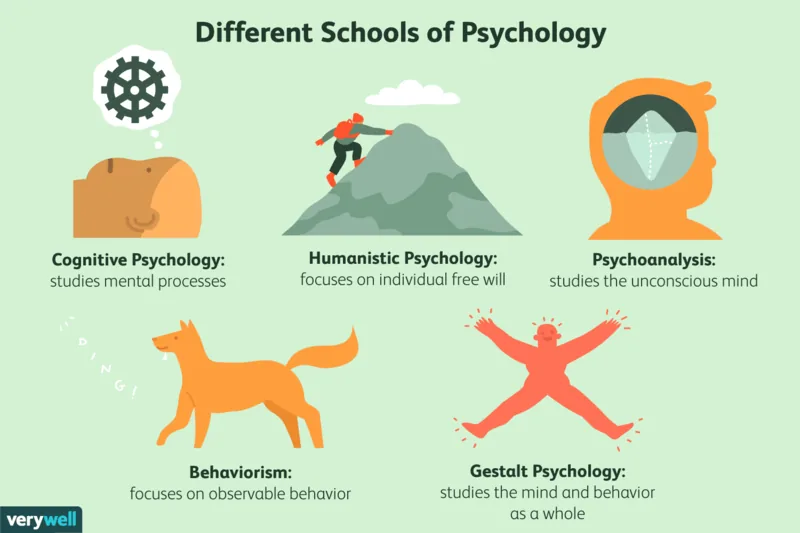
Gestalt psychology arose in Germany in the early 1900s as a reaction against structuralism's reductionist approach. Gestalt theorists--Max Wertheimer, Wolfgang Köhler, and Kurt Koffka--proposed that we experience the world as unified wholes rather than collections of parts. Their famous principle, the whole is greater than the sum of its parts, explains why we see faces in clouds or recognize melodies but not individual notes.
Behaviorism emerged in the early 20th century with John B. Watson's famous claim that psychology should only study observable behavior. Behaviorists rejected the study of consciousness altogether, arguing that psychology should focus exclusively on environmental influences on behavior. This school produced two major learning theories:
- Classical conditioning: Learning through association, as demonstrated by Pavlov's dogs who learned to salivate at the sound of a bell paired with food.
- Operant conditioning: Learning through consequences, where behaviors followed by rewards increase and behaviors followed by punishments decrease.
Behaviorism's influence extends far beyond laboratory settings. For example, many modern workplace motivation systems draw directly from operant conditioning principles, using performance bonuses (rewards) and corrective feedback (negative reinforcement) to shape employee behavior. This practical application demonstrates how behaviorism continues to impact everyday life.
Depth & Meaning: Psychoanalysis & Humanism
While behaviorism focused on observable actions, other schools turned inward to explore the unconscious and human potential. Psychoanalysis and humanism represent two profoundly different approaches to understanding the depths of human experience.
Psychoanalysis
Developed by Sigmund Freud in the late 19th century, psychoanalysis revolutionized psychology by introducing the concept of the unconscious mind. Freud proposed that behavior is driven by unconscious conflicts and desires, many rooted in childhood experiences. His structural model of personality--the id, ego, and superego--remains influential despite considerable controversy.
Freud's emphasis on early childhood influence has shaped modern parenting practices and educational approaches. Many contemporary parenting philosophies incorporate psychoanalytic insights about how early attachment patterns affect emotional development throughout life.
Humanism
Emerging in the 1950s as a reaction against both psychoanalysis and behaviorism, humanism offered a more optimistic view of human nature. Abraham Maslow, Carl Rogers, and others emphasized human potential, free will, and the drive toward self-actualization. Maslow's hierarchy of needs--moving from basic survival needs to esteem and self-actualization--remains one of psychology's most recognizable frameworks.
Humanistic psychology gave rise to positive psychology, which focuses on human strengths and flourishing rather than pathology. Today, positive psychology interventions like gratitude journaling and strength-based coaching have become mainstream approaches to improving wellbeing.
Modern Approaches: Cognitive & Biological Psychology
The latter half of the 20th century saw psychology undergo a cognitive revolution, followed by greater integration with biological sciences. These contemporary approaches represent the final two of the 8 major schools of psychological thought.
Cognitive Psychology
Cognitive psychology emerged in the 1950s as a reaction against behaviorism's limited focus on observable behavior. Instead, cognitive psychologists study internal mental processes like thinking, memory, attention, and problem-solving. This shift gave rise to several influential theories:
- Information processing theory: Comparing the mind to a computer that encodes, stores, and retrieves information.
- Cognitive development theory: Jean Piaget's stages of intellectual development in children.
- Sociocultural theory: Lev Vygotsky's emphasis on social interaction in cognitive development.
Cognitive psychology has transformed our understanding of decision-making. For example, research on cognitive biases like confirmation bias (our tendency to favor information that confirms our existing beliefs) has helped explain why people often maintain beliefs despite contradictory evidence. These insights have practical applications in everything from marketing to political discourse.
Biological Psychology
Biological psychology, also known as behavioral neuroscience, examines how biological processes influence behavior and mental processes. This field explores the relationship between brain structure, genetics, hormones, and neurotransmitters, and psychological phenomena.
Biological approaches have revolutionized mental health treatment. For instance, understanding that anxiety disorders involve dysregulation of neurotransmitters like GABA and serotonin has led to more targeted medications with fewer side effects than earlier treatments. Similarly, research on genetic factors in conditions like depression has enabled personalized treatment approaches.
Modern neuroimaging techniques like fMRI have allowed researchers to observe brain activity during cognitive tasks, providing concrete evidence for theories about how different brain regions contribute to complex behaviors and experiences.
Beyond the Schools: Integrating Perspectives
Today, few psychologists identify exclusively with one of the 8 major schools of psychology. Instead, most take an integrative approach, drawing from multiple frameworks depending on the question being asked. This pluralistic approach reflects psychology's recognition of human complexity.
Consider the case of anxiety treatment--a modern therapist might:
- Use biological approaches (medication targeting neurotransmitter systems)
- Incorporate cognitive techniques (challenging maladaptive thought patterns)
- Apply behavioral strategies (exposure therapy to reduce fear responses)
- Draw from humanistic principles (fostering self-acceptance and growth)
- Even consider psychoanalytic insights about unconscious conflicts)
This integrative approach doesn't represent a rejection of the 8 major schools of psychology but rather their evolution. Each school contributed valuable insights that continue to inform our understanding of human behavior and experience.
As psychology continues to develop, new approaches emerge while older ones adapt and incorporate new findings. Yet the foundational questions remain: What makes us who we are? How do we think, feel, and behave? And how can we apply this understanding to improve human lives?
The 8 major schools of psychology offer different answers to these questions, each highlighting unique aspects of human experience. Together, they provide a comprehensive framework for understanding the complexities of the human mind--a framework that continues to expand with each new discovery.