Imagine standing at the edge of a forest, not just seeing trees, but feeling their ancient energy, hearing whispers of forgotten stories on the wind. This is the threshold of perception that psychedelic drugs can unlock--a world where reality bends, senses intertwine, and the mind embarks on an extraordinary journey. For centuries, these substances have been woven into the fabric of human experience, from sacred rituals to modern scientific inquiry. But what exactly are psychedelic drugs, and what do we need to know about their profound impact on our minds and bodies?
Understanding Psychedelics
Psychedelic drugs, often called hallucinogens, are a class of substances that profoundly alter perception, mood, and cognitive processes. Unlike stimulants or depressants, their primary effect is to induce changes in sensory experience, thought patterns, and a sense of self. This can manifest as vivid hallucinations--seeing, hearing, or feeling things that aren't there--and a blurring of the lines between internal experience and external reality. The term 'psychedelic' itself, derived from Greek words meaning 'mind-manifesting,' hints at their capacity to reveal hidden aspects of consciousness (Nichols, 2016).
While often associated with recreational use, a growing body of research is exploring what are psychedelic drugs in the context of therapeutic applications. Early studies suggest potential benefits for conditions like depression, anxiety, and PTSD, though these treatments are still experimental and legally restricted. It's crucial to understand that their use, whether for exploration or potential healing, is complex, carrying both risks and possibilities.
A Journey Through Time: History and Modern Research
The use of mind-altering substances stretches back millennia. Indigenous cultures across the globe have long incorporated plants containing psychoactive compounds into spiritual ceremonies, seeking connection with the divine, enhanced intuition, or profound personal insight. For example, the Native American Church utilizes peyote in sacred rituals, a practice legally protected despite mescaline, its active compound, being a controlled substance in the U.S. (Fuentes et al., 2020).
Interest in psychedelics surged in the mid-20th century, particularly in Western psychotherapy, where they were explored for treating various mental health conditions. However, political shifts and societal concerns led to widespread prohibition in the 1970s, effectively halting much of this research. Today, there's a resurgence of scientific interest, driven by promising preliminary findings and a desire to understand what are psychedelic drugs from a clinical perspective. Researchers are meticulously designing studies to investigate their therapeutic potential, with regulatory bodies like the FDA beginning to provide guidance for safe and effective research protocols (FDA, 2023).
This renewed focus is not just about recreation; it's about understanding how these substances might offer novel pathways to healing. However, it's vital to reiterate that what are psychedelic drugs in a clinical setting is still very much an area of active investigation, and access outside of controlled research remains limited.
The Diverse Spectrum of Psychedelics
The world of psychedelics is vast, encompassing substances derived from both natural sources and chemical synthesis. Each carries its own unique profile of effects, duration, and potential risks.
LSD (Lysergic Acid Diethylamide)
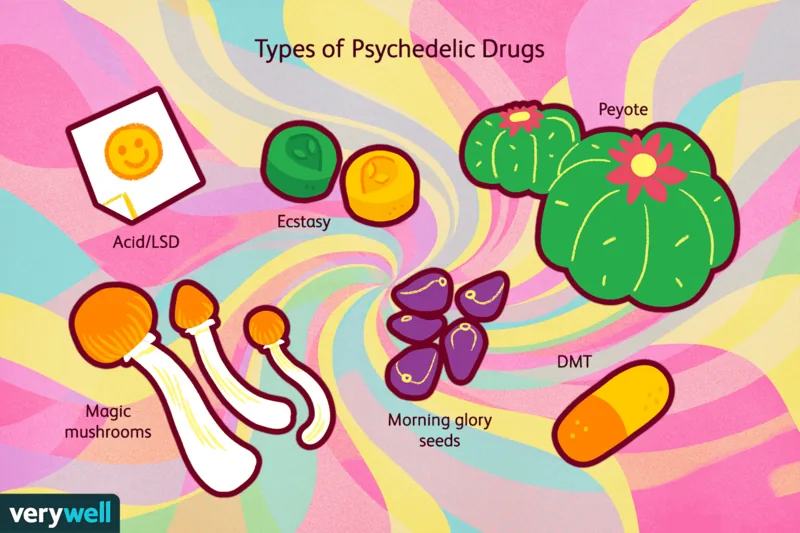
Known widely as 'acid,' LSD is a potent synthetic compound derived from ergot, a fungus found on rye. Its effects can last for many hours, significantly altering sensory perception, thought, and emotions. Once a subject of intense research, its illicit status has persisted despite its historical use and ongoing underground presence.
Psilocybin (Magic Mushrooms)
Found in over 100 species of fungi, psilocybin is perhaps one of the most well-known natural psychedelics. Often referred to as 'magic mushrooms,' these fungi grow wild in many parts of the world. While their legal status can be ambiguous, certain cities and regions have begun decriminalizing psilocybin. However, what are psychedelic drugs like mushrooms also brings the significant risk of misidentification, as some varieties are highly toxic and potentially lethal.
DMT (Dimethyltryptamine)
DMT is a powerful psychedelic compound found in numerous plants, particularly in the Amazon basin, where it's a key component of ayahuasca, a traditional ceremonial brew. Its effects are known for their intensity and relative brevity, often lasting only about an hour. This rapid onset and short duration make it distinct from many other psychedelics.
Mescaline (Peyote)
Mescaline is the active compound in the peyote cactus and other related species. Indigenous peoples have used peyote for centuries in spiritual practices. While it's a Schedule I controlled substance in the U.S., its religious use by members of the Native American Church is legally exempted. Its effects are comparable to LSD, though often with a more grounded, earthy quality.
MDMA (Ecstasy/Molly)
While often grouped with psychedelics, MDMA occupies a unique space. It acts as both an empathogen and a mild psychedelic, primarily enhancing feelings of connection and reducing inhibitions, with less pronounced visual hallucinations compared to LSD or psilocybin. Its therapeutic potential, particularly in conjunction with psychotherapy for conditions like PTSD, is a significant area of current research (Tupper et al., 2015).
The Landscape of Psychedelic Effects
The experience of taking a psychedelic substance is intensely personal and variable. Factors like the specific drug, dosage, individual mindset, and the surrounding environment (the 'set and setting') all play crucial roles in shaping the journey. What one person experiences can be vastly different from another's encounter.
Common effects include:
- Profound alterations in the perception of time, which may seem to slow down, speed up, or stop altogether.
- Intensified sensory experiences, where colors appear more vibrant, sounds richer, and touch more profound.
- Synesthesia, a phenomenon where senses become mixed, such as 'seeing' sounds or 'tasting' colors.
- A heightened sense of introspection and self-awareness, sometimes leading to deep emotional processing or spiritual insights.
- Hallucinations, ranging from subtle visual distortions to complex, vivid imagery.
- Challenges in clear communication due to altered thought processes.
- Physical effects can include increased heart rate, blood pressure, body temperature, nausea, and dilated pupils. For example, LSD might cause dizziness and dry mouth, while psilocybin can sometimes induce anxiety or paranoia in certain individuals (Graziano et al., 2017).
The intensity and nature of these effects underscore the importance of caution and responsible exploration, especially given the ongoing research into their therapeutic applications.
Tolerance, Addiction, and Safety
A key question regarding what are psychedelic drugs often revolves around their addictive potential. Generally, psychedelics are not considered physically addictive in the way opioids or stimulants are. Addiction is typically characterized by compulsive drug-seeking behavior despite negative consequences, and this pattern is not commonly associated with classic psychedelics like LSD or psilocybin (National Institute on Drug Abuse).
However, the body can develop a tolerance to these substances relatively quickly. This means that after repeated use within a short period, higher doses are needed to achieve the same effects. This tolerance usually subsides within a few days of abstaining. Importantly, cross-tolerance can occur; for instance, someone who has taken LSD might find that psilocybin or mescaline has a reduced effect.
While not typically leading to addiction, the risks associated with psychedelic use should not be overlooked. These include the potential for difficult psychological experiences ('bad trips'), temporary impairments in judgment, and the aforementioned risks of misidentification with wild-harvested fungi. For those struggling with substance use, reaching out for professional help is a sign of strength. Resources like the SAMHSA National Helpline are available to provide confidential support and information on treatment options.