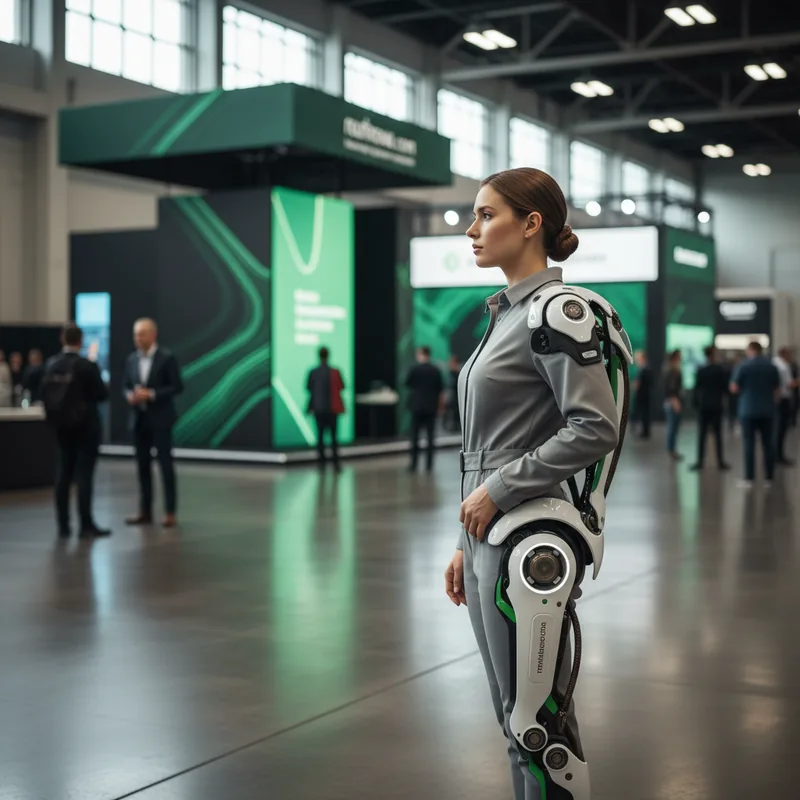
The future of personal mobility might be clunkier than you think. After strapping into six different exoskeletons at CES, I discovered that while the technology is undeniably impressive, it's not quite ready to revolutionize your daily walk - yet.
The Exoskeleton Exodus at CES
CES, the sprawling Consumer Electronics Show in Las Vegas, is a fertile ground for futuristic tech. This year, a growing number of exoskeletons promised to enhance human capabilities, from extending endurance for hikers to aiding those with mobility challenges. My personal mission during the event was to test as many of these wearable robotic suits as possible. I ended up trying six distinct models: four focused on hip assistance, one on the knee, and one on the ankle. This deep dive offered a unique perspective on what I learned after experiencing this cutting-edge technology firsthand.
My initial exposure to exoskeletons came through the lens of "age tech," devices designed to support aging populations. While judging such products, I was intrigued by mobility aids but remained skeptical about their safety, reliability, and practical convenience for everyday users. Despite the hype, none made it to the finalist round of our judging panel, leaving the question of their market readiness open.
Many companies are positioning their exoskeletons as fitness enhancers. Marketing materials often feature athletes conquering mountains or hikers effortlessly navigating trails. One colleague, testing a hip-assist model, reported an easier time keeping pace with experienced hikers on a challenging trail. I even borrowed that same unit for some impromptu sprints down a convention center hallway, an experience that offered a taste of the technology's potential.
This exploration wasn't just about the specs; it was about the feeling, the functionality, and the future. What follows is a rundown of my experiences, ranked from least to most favorite, followed by a broader discussion on their current utility and what I learned after consulting with an expert in medical-grade exoskeletons.
Ranking the Wearable Robots
The journey through CES's exoskeleton offerings was a mixed bag, with some devices offering subtle support and others feeling surprisingly potent. Here's a look at the models I tested:
Least Favorite: WiRobotics WIM-S ($1,905)
The WiRobotics WIM-S was the final exoskeleton I tested, and unfortunately, it landed at the bottom of my personal ranking. Its minimalist design and slim profile were appealing, but the actual assistance was barely perceptible. While I walked up and down a small demo staircase, the WIM-S seemed to do little to augment my movement. The device's design places the assistance mechanism in front of the hips, providing a push that felt more like manually helping yourself stand up rather than a seamless technological enhancement.
Currently, the WIM-S is not available for sale in the U.S., which might explain some of the technological immaturity observed during my brief test.
Promising Assistance: Sumbu S3 Series ($1,199-$1,999)
My first encounter with Sumbu was at a media preview event. Strapping into the device involved a waist belt and leg cuffs, and I immediately felt its assistance. Walking felt more supported, and a quick jog in place confirmed its potential. Later, at the startup-focused Eureka Park, I tested it on a miniature staircase. The Sumbu exoskeleton made stepping up significantly easier, even when taking stairs two at a time. It also helped me step onto a platform three stairs high with surprising ease.
It's worth noting that the Sumbu, Ascentiz, and Hypershell models offered a similar feel, making fine distinctions difficult after short trials. Sumbu offers three models: the lightweight S3 ($1,199), the more powerful S3 Pro ($1,499), and the top-tier S3 Ultra ($1,999).
Smooth and Supportive: Ascentiz ($1,499 and up)
Ascentiz offers a modular exoskeleton system that can assist at both the hip and knee, though I only tested the hip module. This hip-focused design, like most I encountered, functions like a hinge, assisting with hip extension and flexion - the forward and backward leg movements crucial for walking and running. The assistance targets glutes and hip flexors, mimicking natural motion.
The Ascentiz booth was strategically placed near stairs and an open area, perfect for testing. Climbing stairs felt effortless, and subsequent jogs and even a sprint felt smooth and natural. The power delivery was well-timed, seamlessly integrating with my stride. Ascentiz is currently seeking Kickstarter funding, with the hip module (H1) priced from $699-$999 during the campaign, and a retail price of $1,499-$1,999. The knee module (K1) adds about $100, with a full hip and knee system ranging from $2,499 to $3,399.
Athletic Performance: Hypershell X Ultra ($1,999)
I borrowed the Hypershell X Ultra from a colleague for a more extensive test, including sprints and quick turns in the convention hallways. This was the first hip-based exoskeleton I attempted to run in, and the experience was surprisingly positive. Compared to Ascentiz, which also felt good for running, the Hypershell offered a more seamless integration. It was less prone to misinterpreting my movements, unlike some other models that would activate when I was stationary.
The Hypershell's maturity might stem from its longer presence in the market as a consumer outdoor exoskeleton. The X Ultra costs $1,999, with the Hypershell Go available for a more accessible $899. This model demonstrated a significant leap in responsiveness and performance, enhancing my ability to move quickly and change direction.
Knee Support: Skip Mo/Go ($4,999)
Found in the AARP AgeTech Collaborative section, the Skip Mo/Go is unique as it's integrated into pants and targets knee assistance. It functions like an artificial quad muscle, aiding in knee extension and providing crucial support during descent. Having personal experience with knee pain and surgery, I immediately recognized the value of this device. It gently assisted me in sitting down and standing up, preventing the jarring "plop" often associated with losing muscle support.
While running felt awkward, the primary function of supporting knee movement was evident. The main drawback was comfort; the internal cuffs against bare skin felt sweaty and potentially chafing. The pants also required some effort to put on, which could be a hurdle for individuals with significant mobility issues. The representative mentioned the motor unit is detachable, which would likely improve comfort. The Skip Mo/Go is pre-order only, with an expected price of $4,999.
Powered Footwear: Dephy Sidekick ($4,500)
Dephy's "powered footwear," the Sidekick, is an ankle-based exoskeleton designed to assist calf muscles. It consists of a comfortable shoe with a carbon plate and a robotic arm attaching below the knee. The system activates after a few steps, providing a heel lift that propels the user forward. This felt like the most thoughtfully designed and comfortable exoskeleton I tried. The attachment points - the shoe and a shin pad - were unobtrusive, and the device was quick to put on and take off.
The Sidekick's intelligence lies in its programming. It assists forward motion but disengages during sideways or unexpected movements, enhancing safety. I experienced this firsthand when I dodged an obstacle, and the exoskeleton paused assistance before resuming its forward propulsion. This responsiveness was reassuring, especially when considering potential users with mobility challenges. The system, including shoes, batteries, and charger, costs $4,500 and begins shipping soon.
The Real-World Utility of Exoskeletons
After testing six different models, my initial skepticism has shifted. Five of the six exoskeletons provided tangible, helpful assistance. This alone exceeded my expectations and demonstrated that the core technology is functional. The key questions now revolve around cost-effectiveness and practical application for the target audience.
The price point remains a significant barrier. Spending $1,000 to $5,000 for enhanced walking or hiking assistance is a tough sell for the average consumer. Serious athletes might prefer investing in training or better gear, while casual users might find the cost prohibitive for occasional recreational use. However, the potential for a rental market seems viable - imagine renting a Hypershell for a challenging hike or Dephy's footwear for a day at an amusement park.
My most pressing question was about the impact on individuals with mobility issues stemming from disabilities or chronic health conditions. To explore this, I spoke with an expert deeply involved in medical exoskeleton applications.
Medical vs. Consumer Exoskeletons: A Stark Contrast
Amanda Clark, director at Good Shepherd Creates and a physical therapist, has over a decade of experience with exoskeletons in rehabilitation settings. Her facility utilizes advanced devices like the EksoNR, Indego Personal Exoskeleton, and ReWalk, which can enable individuals to walk who previously couldn't, or aid recovery from conditions like strokes and spinal cord injuries. These medical-grade systems are incredibly sophisticated, enabling extensive rehabilitation by promoting balance and walking practice (Clark, personal communication, 2024).
The cost of these medical devices is substantial, often reaching $250,000 for a single unit, plus annual maintenance fees. They typically require assistive devices like walkers and the constant supervision of a physical therapist or caregiver. The lengthy and expensive process of obtaining FDA approval as a medical device, involving rigorous clinical trials for safety and efficacy, explains the clear distinction companies make between their consumer and medical products.
This distinction is crucial because consumer devices are rarely covered by insurance. For individuals with disabilities or chronic conditions, particularly those facing employment challenges, the cost of $1,000-$5,000 is an insurmountable hurdle. Furthermore, the novelty of these consumer models raises concerns about long-term reliability, safety, and the company's longevity - factors critical for ongoing support.
Clark emphasizes the need for accessible solutions: "My challenge to these companies is: how do you create something that is user-friendly, that is slim profile, that could really promote these changes in independence and quality of life--but at a price point or in a way that is accessible to them?" (Clark, personal communication, 2024).
This sentiment resonates with my findings. The technology shows immense promise, especially for those needing mobility assistance. However, at current price points, accessibility is limited for both individuals with mobility challenges and recreational users seeking performance enhancement. What I learned after this CES experience is that while the technology is advancing rapidly, significant strides in affordability and practical application are needed before exoskeletons become a mainstream solution for widespread mobility enhancement.
The Road Ahead for Wearable Robotics
The rapid progress in making exoskeletons lighter and more wearable outside clinical settings is encouraging. Companies are clearly investing in innovation, and the potential for these devices to improve independence and quality of life is immense. However, the economic realities are stark.
For individuals who could benefit most from these devices - those with disabilities or age-related mobility decline - the cost is often prohibitive. Insurance coverage is virtually non-existent for consumer-grade technology, creating a significant gap between potential benefit and actual access. This is a critical area where industry innovation must meet societal need.
Looking forward, I anticipate seeing improvements in both cost and functionality. Perhaps a tiered pricing model, a robust rental market, or even government subsidies could make these devices more attainable. The potential applications are vast: assisting construction workers with heavy lifting, enabling faster recovery for athletes, or simply allowing seniors to maintain an active lifestyle with greater ease. What I learned after this extensive testing is that the journey from CES prototype to everyday reality is complex, but the destination holds incredible promise.
As these technologies mature, the biggest hurdle will be bridging the gap between advanced engineering and widespread affordability. The promise of enhanced mobility and independence is compelling, but it must become accessible to truly change lives. The evolution of exoskeletons is a marathon, not a sprint, and I'm eager to see what the next lap brings.