The human brain is an extraordinary marvel, constantly adapting and evolving throughout our lives. Far from being a static organ, it embarks on a lifelong journey of transformation, shaping who we are, how we think, and how we experience the world. Understanding these profound changes is key to nurturing our mental health and maximizing our cognitive potential at every stage. Recent groundbreaking research published in Nature Communications (Mousley et al., 2025) has illuminated this journey, defining five distinct brain epochs: development stages that characterize our neural architecture from infancy to our golden years. These five brain epochs: development provide a complete guide to the structural evolution of our minds, revealing critical turning points that influence our cognitive abilities, emotional resilience, and overall well-being.
1. Unlocking the Secrets of Lifelong Brain Development
Our brains are not just highly complex organs; they are dynamic systems that continuously reshape themselves in response to genetics, experiences, and environment. This continuous process of human brain development ensures our capacity for learning, adaptation, and growth throughout our entire lifespan. From the rapid expansion of neural connections in childhood to the refined specialization of later years, each phase brings unique strengths and challenges. New insights into these brain epochs: development stages offer a clearer roadmap for understanding mental health vulnerabilities and opportunities for intervention.
For decades, scientists have sought to model this intricate journey, moving beyond simplistic ideas of fixed brain states. The latest research provides an unprecedented view into how structural brain networks evolve, offering a nuanced perspective on our neural development epochs. This understanding empowers us to make informed lifestyle choices that support brain health at every age, fostering cognitive vitality and emotional balance. By recognizing these distinct phases, we can better tailor our approach to education, mental well-being, and preventive care, ensuring a healthier and more resilient mind for life. This comprehensive view of brain development stages highlights the importance of continuous engagement and support for optimal function.
2. The Groundbreaking Research: Mapping Brain Epochs
A landmark population-level analysis published in Nature Communications (Mousley et al., 2025) is revolutionizing our understanding of brain changes through life. This extensive study analyzed diffusion MRIs, a specialized form of magnetic resonance imaging that maps “tractography,” or the intricate flow and connections between different brain regions and networks. Researchers examined data from an impressive 4,216 individuals, spanning all ages from birth to 90 years old, to chart how these structural brain networks evolve over time. This robust methodology allowed for an unparalleled look at lifespan brain changes.
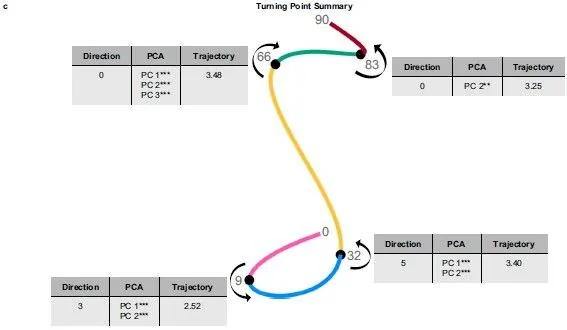
The work, lauded for its complexity and elegance, revealed four critical “turning points” in brain development, occurring approximately around ages 9, 32, 66, and 83. These turning points delineate five distinct brain epochs: development, each possessing its own unique neural fingerprint. Unlike previous models that often focused on isolated peaks in development, this advanced multivariate, non-linear approach captures how numerous brain network features shift in concert at these key ages. This provides a far more comprehensive and nuanced picture of brain evolution, moving beyond single-factor explanations to embrace the full complexity of human brain development. Such insights are crucial for future precision medicine strategies (Harvard, 2024).
3. Epoch 1: The Foundations of Childhood (Ages 0-9)
The initial brain epoch: development spans from birth to approximately age 9, a period characterized by explosive growth and rapid organization. During this foundational stage, the brain undergoes significant structural changes. We observe a decreasing global integration, meaning the brain starts to refine its widespread connections, alongside an increasing local segregation. This process allows specialized areas to develop their unique functions more effectively. Concurrently, “small-worldness” — an optimal balance between local specialization and global integration — rises, making the brain efficient for processing information.
Developmentally, this epoch is marked by crucial biological processes such as synaptic pruning, where unused neural connections are eliminated to streamline networks, and increased myelination of neurons, which involves the formation of fatty sheaths that dramatically speed up nerve impulses. The brain’s surface also undergoes increased folding, creating more surface area for cognitive processing within the skull. Cognitively, children achieve significant milestones, including language acquisition, refined attention spans, and the emergence of early executive functions like planning and problem-solving. This is also when neurodevelopmental differences and early risks for internalizing (e.g., anxiety) or externalizing (e.g., acting out) mental health challenges may become apparent. For optimal development, fostering secure attachment, providing a rich and stimulating early environment, and supporting social-emotional learning through activities like reading aloud, sensory play, and structured games are paramount. These early experiences lay the groundwork for all subsequent brain development stages.
4. Epoch 2: Adolescence and Early Adulthood (Ages 9-32)
This second brain epoch: development, extending from around age 9 to 32, is aptly described as “the long adolescence of the connectome.” It’s a period of intense reorganization and maturation, deeply influenced by both biological shifts (like puberty) and complex psychosocial factors. During this time, the brain experiences a surge in integration and small-worldness, indicating a growing capacity for complex thought and interconnected processing. While global modularity (how distinctly separate brain systems are) decreases, local specialization paradoxically strengthens, suggesting a sophisticated balance of broad communication and focused function. Small-worldness emerges as the strongest predictor of brain network organization during this phase.
This epoch is a critical window for identity formation, skill development, and navigating complex social landscapes. However, it also carries a higher mental health risk, with increased vulnerabilities to mood and anxiety disorders, psychosis spectrum conditions, and substance use. Opportunities during this phase are immense, focusing on building resilience through problem-solving skills and coping mechanisms, supporting smooth transitions from education to work, and fostering strong social support networks. Prioritizing adequate sleep and maintaining circadian alignment are also crucial for brain health. Engaging in new learning experiences, such as mastering a new language or musical instrument, can further enhance neural plasticity and cognitive flexibility during these vital neural development epochs.
5. Epoch 3: Midlife’s Cognitive Consolidation (Ages 32-66)
The third brain epoch: development, spanning from approximately age 32 to 66, represents a phase of midlife consolidation and rebalancing. As individuals move into their thirties, the brain begins a gradual decline in global integration, coupled with a steady increase in segregation and modularity. This suggests a shift from broad adaptability to more specialized and efficient processing within established networks. Local efficiency and clustering become strong predictors of brain function, indicating that well-worn pathways are optimized for performance. Interestingly, average connection strength rises during this time, even as unused or less efficient long-range connections may fade, streamlining neural communication.
Developmentally, cognitive performance tends to plateau, and personality traits become more stable. This period is often characterized by significant life stressors related to family responsibilities, career demands, and the emergence of increased medical risks that can profoundly impact brain health, such as cardiovascular and metabolic conditions. Prevention becomes a cornerstone for maintaining cognitive vitality. Actionable steps include consistent physical activity (e.g., brisk walking, yoga, strength training), vigilant blood pressure and glucose control, regular hearing and vision care, effective cognitive load management (e.g., mindfulness, delegating tasks, prioritizing), and robust stress regulation techniques (e.g., meditation, engaging in hobbies, spending time in nature). These practices are essential for preserving optimal brain function during these crucial lifespan brain changes.

6. Epoch 4: Adapting to Later Life (Ages 66-83)
Entering the fourth brain epoch: development, from roughly age 66 to 83, we observe an acceleration of aging reorganization within the brain’s networks. During this period, modularity emerges as the most robust age-associated feature, continuing to strengthen while global integration experiences a modest but steady decline. This signifies a brain that is increasingly organized into highly specialized, somewhat independent modules, which can be both a strength and a vulnerability. While this modularity can enhance efficiency for well-practiced tasks, it may also contribute to reduced flexibility and adaptability to novel situations.
Developmentally, this epoch is often accompanied by an increasing prevalence of medical problems, and critically, the risk of dementia rises significantly. The clinical and lifestyle focus during this phase shifts towards proactive strategies for maintaining brain health. Key actionable steps include comprehensive dementia prevention efforts, such as adhering to a Mediterranean diet, maintaining vibrant social engagement, and regular cognitive stimulation (e.g., learning new skills like coding or painting, engaging in complex puzzles). Prioritizing overall brain and physical health, along with embracing lifelong learning, becomes paramount for supporting cognitive function and emotional well-being. This period underscores the dynamic nature of brain epochs: development and the power of proactive choices.
7. Epoch 5: Navigating the Golden Years (Ages 83+)
The final brain epoch: development encompasses individuals aged 83 and beyond, a phase marked by diverging paths and unique adaptive strategies. In this period, the brain exhibits weaker coupling between age and its overall topological structure, meaning that individual variability becomes much more pronounced than in earlier epochs. While some general trends persist, the specific trajectory of brain aging becomes highly personal, influenced by a lifetime of genetics, experiences, and health choices. Interestingly, subgraph centrality — a measure of how central specific regions are within subnetworks — increases in select core areas, potentially enhancing redundancy. This could serve as a protective mechanism, increasing resilience in vital brain functions even as other areas may decline.
Developmentally, this epoch highlights the increasing importance of staying physically active and mentally engaged to avoid frailty and preserve overall healthspan. The variability from person to person is immense, with some individuals maintaining remarkable cognitive sharpness and physical vitality, while others face significant challenges. Care models during this phase increasingly focus on person-centered goals, emphasizing individual preferences and autonomy. Advanced care planning becomes crucial, alongside robust community supports to combat loneliness and reduce caregiver strain. Examples of beneficial activities include adapted exercise programs like chair yoga, engaging in intergenerational activities, and reminiscence therapy. These strategies are vital for supporting well-being through these advanced neural development epochs.
8. Future Horizons: Precision Brain Health in 2025
The insights gained from understanding these brain epochs: development stages are not just theoretical; they hold immense promise for the future of mental health and cognitive enhancement. We are on the cusp of a new era of precision interventional psychiatry (PIP), where treatments can be tailored with unprecedented accuracy to an individual’s unique brain profile and developmental stage. Imagine a future where neuromodulation techniques, such as transcranial magnetic stimulation (TMS), are precisely applied based on real-time brain network assessments.
Emerging office-based measurement tools like functional near-infrared spectroscopy (fNIRS) and electroencephalography (EEG) could soon provide instant feedback on brain activity, guiding interventions. In 2025 and beyond, the integration of artificial intelligence (AI) will be pivotal. AI-enabled analytic tools will process richer, longitudinal datasets, allowing us to identify which factors shift individual brain trajectories over time. This will pave the way for precision prevention and intervention strategies, timing support for learning, resilience-building, and treatment to protect cognition and mental health across the entire lifespan. We might even envision a future where we can “program” desirable connectivity patterns, moving beyond disease treatment towards regenerative medicine and performance enhancement, optimizing each of the brain development stages for peak potential.