Does everything feel like too much these days? We’ve all been there: meticulously building a life, carefully curating routines, and arming ourselves with every self-help tool imaginable, only to find ourselves crumbling when life truly hits. The paradox is stark: the more we try to hold ourselves together, the more fragile we often become. This is precisely why letting myself fall apart wasn't a failure, but the unexpected key to my deepest sense of freedom.
The Illusion of Invincibility: When Our Best Efforts Backfire
I had ten days to dismantle my life in Toronto and rebuild it in Florida. Ten days to pack only what fit in my SUV, confidently shedding the rest. It felt like a conscious, aligned decision—the kind of intentional choice someone who had truly 'done the work' would make. But what I hadn’t anticipated was the cascade of other seismic shifts happening simultaneously.
During that intense period, I discovered thousands of dollars in unexpected car repairs were needed just to buy out my lease. A close friend called, deeply hurt by how I’d handled a sensitive issue, shaking my sense of self more than I cared to admit. Then came the agonizing decision to rehome my beloved rescued dog after three years, a quiet grief that settled deep in my bones. I was leaving the place where I’d found profound stability and become the woman I’d worked so hard to be, moving into a new country with a new partner. It was a relentless layering of change, all under a tight, self-imposed deadline.
Despite years spent cultivating mindfulness, reflection, and emotional awareness, I felt like I was spiraling. Every morning, I doubled down on my practices: journaling, meditating longer, adding more breathwork, hitting the gym. I chanted affirmations to stay grounded, present, and grateful. Yet, none of it was working. I was a knot of anxiety, perpetually on the verge of tears, overwhelmed and embarrassed by my own emotional intensity. The thought, “I should be able to handle this better,” became its own suffocating pressure.
Think about it: we often use our carefully constructed wellness routines not to process emotions, but to control or even suppress them. We might meditate to 'calm down' a challenging feeling rather than simply observe it, or journal to 'solve' an emotional problem instead of just letting it be. This subtle misuse of powerful tools can leave us feeling even more fragmented when they inevitably fail to 'fix' what isn't broken, only felt.
The Unraveling: Discovering Strength in Surrender
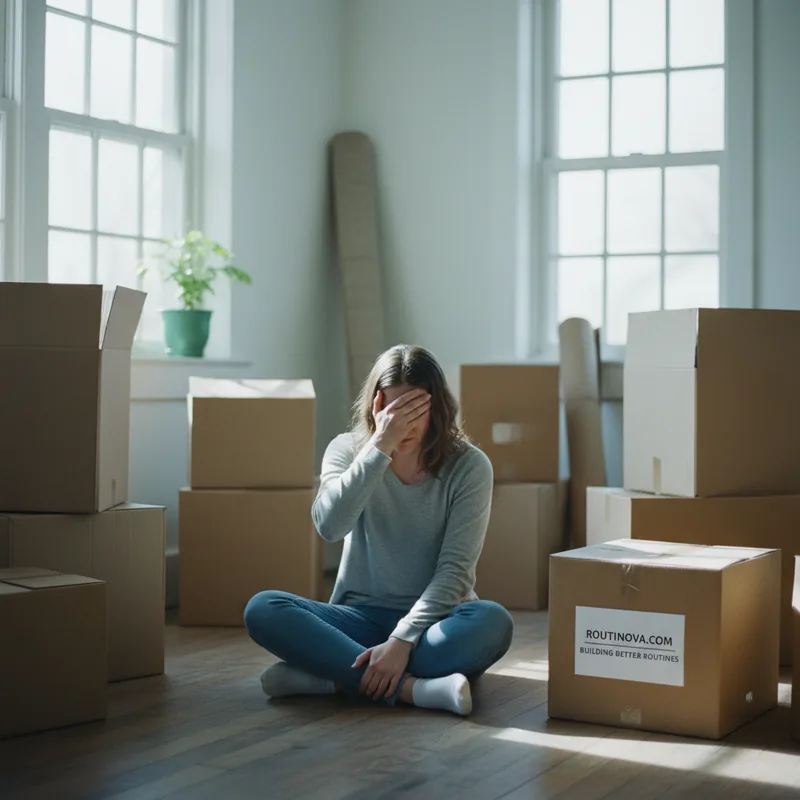
One afternoon, my partner and I stood in my storage unit, trying to pack the last of my belongings. We were shoving boxes into impossible spaces, including items that had belonged to my father, who had passed years ago – things I was still not ready to fully release. Suddenly, I simply couldn’t do it anymore. There was no internal negotiation, no conscious decision to 'allow.' I didn't talk myself through it, didn't breathe my way out, didn't reach for perspective. I just cried.
Right there, surrounded by boxes, by grief, and by sheer exhaustion, I broke down. I cried in front of my partner, without apology or explanation. For the first time in what felt like weeks, I stopped trying to stay composed. And in that raw, messy moment, something profound shifted. It wasn't because the situation changed, but because I finally let myself feel it.
In that instant, I saw what had been invisible before: my struggle wasn't the emotion itself. My struggle was my deep-seated belief that I wasn’t supposed to feel that way. Sadness was a sign I wasn't healed enough. Overwhelm meant I wasn't grounded. Being triggered felt like a personal failure. This constant judgment and resistance, rather than the feelings themselves, had been draining my energy and keeping me trapped (University of California, 2022).
This is precisely why letting myself fall was a revelation. It wasn't about finding a new coping mechanism, but about abandoning the need for one at all. Just as a friend once shared her experience of a public panic attack—initially mortified, she later realized the overwhelming wave passed much faster when she stopped trying to 'contain' it, finding a strange release in the sheer public vulnerability.
Redefining Resilience: Embracing Emotional Flow
What I finally understood, standing there amidst the remnants of my old life, was that peace isn't something we maintain by rigidly holding ourselves together. It’s something we return to after we let ourselves feel. My emotions weren't the problem; my resistance to them was.
I had been using all the right tools – breathwork, meditation, journaling – but with the wrong intention. Instead of allowing my feelings to move through me like waves, I was trying to control them, to ensure I didn’t feel 'too much.' I hadn’t realized the immense energy that kind of self-management consumed until I stopped doing it. After my storage unit breakdown, I asked my partner for space. I lay on my bed and simply let everything spill out.
For ten minutes, I cried, I shook, I spoke out loud to no one in particular, releasing the grief, guilt, fear, and the intense pressure I’d placed on myself to handle it all with grace. I didn’t try to make it sound resolved or stop myself when my voice cracked. I just let it move. And when it was done, something surprising happened: I felt lighter. Not because my circumstances had changed, but because the emotion had passed through, rather than getting trapped inside me. This pivotal moment solidified why letting myself fall was so transformative.
The more I practiced allowing emotions to pass through me—without judgment or urgency—the easier it became. I noticed a profound shift: the emotions didn’t last as long. When I didn’t resist them, they moved faster. When I didn’t label them as failure, they softened sooner. The whole experience felt cleaner, more honest, and far less exhausting. This aligns with modern somatic therapies, which emphasize the body's natural capacity to process and release strong emotions when given the space (Sensorimotor Psychotherapy Institute, 2023).
The Liberating Truth: Growth Isn't About Never Falling Apart
I realized I didn’t actually need to always have it together. I had lived with an unspoken rule that being truly grounded meant being perpetually composed, that genuine growth meant I wouldn't 'fall apart' anymore. But that day showed me the opposite. The relief didn't come from staying regulated; it came from releasing the exhausting pressure to be regulated at all times. What I found wasn't collapse, but profound freedom.
Freedom from constantly monitoring myself. Freedom from labeling emotions as good or bad. Freedom from turning every feeling into something that needed to be managed or fixed. This is the essence of emotional freedom: trusting ourselves to move through whatever arises. It’s a powerful lesson in self-compassion, recognizing that our humanity includes a full spectrum of feelings (Kristin Neff, 2024).
I began to see peace less as a fragile, permanent state I needed to protect, and more as a steady place I could always return to. A reset. That didn’t mean I stopped feeling deeply; if anything, I felt more. But the feelings no longer scared me. They no longer signaled unraveling or going backward. They became part of the vibrant movement of being alive—signals, waves that rose and passed. I could feel sadness without becoming it. I could feel overwhelm without drowning in it. I could feel grief without believing something was fundamentally wrong with me.
Looking back now, I don’t see that intense season as a breakdown. I see it as a recalibration. A powerful reminder that growth doesn’t mean we stop being human; it means we stop abandoning ourselves when being human gets uncomfortable. And once you experience the liberating truth of why letting myself fall was the path to genuine steadiness, you don’t forget it. You remember that you don’t need to hold yourself together to be okay. You just need to let yourself be real—and trust that steadiness knows how to find you again.